
AI writing tools have become part of the everyday SEO workflow.
You can use them to build outlines, research topics, rewrite awkward sections, create title ideas, draft meta descriptions, and turn rough notes into a usable first draft.
The catch is that every tool handles SEO differently. Some are general writing assistants. Others are built around SERP analysis, content scoring, AI search visibility, or marketing workflows.
So the right choice depends on what you actually need to do.
Here are the best AI writing tools to consider in 2026, with a focus on SEO, blogging, WordPress, and content marketing.
Quick comparison
| Tool | Best for | SEO features | Starting paid price* |
|---|---|---|---|
| ChatGPT | General SEO writing and research | Research, outlining, rewriting, analysis | Varies by plan |
| Jasper | Marketing teams and brand voice | Brand knowledge, marketing workflows, GEO tools | $69/month |
| Surfer | SEO-focused content creation | SERP analysis, content scoring, AI writing | $49/month billed yearly |
| Writesonic | SEO and AI search visibility | AI articles, site audits, AI visibility tracking | $79/month billed yearly |
| Frase | Content research and ongoing SEO | SEO/GEO scores, audits, internal links | $39/month billed yearly |
| Copy.ai | Marketing workflows | AI writing, workflows, multiple AI models | $29/month |
| Grammarly | Editing and rewriting | Grammar, clarity, AI rewriting | $12/month |
Prices can change. Check the provider’s current pricing page before subscribing.
1. ChatGPT
ChatGPT is useful when you want one flexible writing assistant that can handle different parts of the SEO process.
You can use it for keyword clustering, content briefs, article outlines, title ideas, FAQ drafts, internal-link suggestions, rewrites, content audits, and editing.
The biggest advantage is flexibility. You can give it your existing article, target keyword, audience, brand voice, and formatting rules, then work through the article section by section.
For SEO, I find that workflow much more useful than asking an AI to generate a complete article from one sentence.
Good uses for SEO
- Building article outlines
- Grouping related keywords
- Turning research into content briefs
- Rewriting weak paragraphs
- Creating FAQs
- Reviewing search intent
- Writing title and meta description ideas
- Comparing competing content
- Creating internal-link suggestions
- Editing content for readability
ChatGPT can also work with files and research workflows, depending on the plan and features available to you.
Best for: bloggers, freelancers, small businesses, and SEO professionals who want a flexible writing assistant.
2. Jasper
Jasper is aimed heavily at marketing teams.
Its current platform includes brand voices, knowledge assets, audiences, marketing agents, workflows, and integrations. Jasper’s Pro plan is currently listed at $69 per month when billed monthly or $59 per month when billed yearly.
That makes it a different proposition from a general chatbot.
You can give Jasper information about your brand and use that context across marketing content. Its Business plan also includes more advanced marketing workflows and GEO-related features.
Good uses for SEO
- Blog briefs
- Content campaigns
- Brand-controlled writing
- Landing-page copy
- Social content
- Email marketing
- Content repurposing
- Marketing workflows
Jasper makes more sense when several people are creating content for the same company.
For a solo blogger publishing 4 articles a month, the price may be harder to justify.
Best for: marketing teams and businesses that need consistent brand-controlled content.
3. Surfer
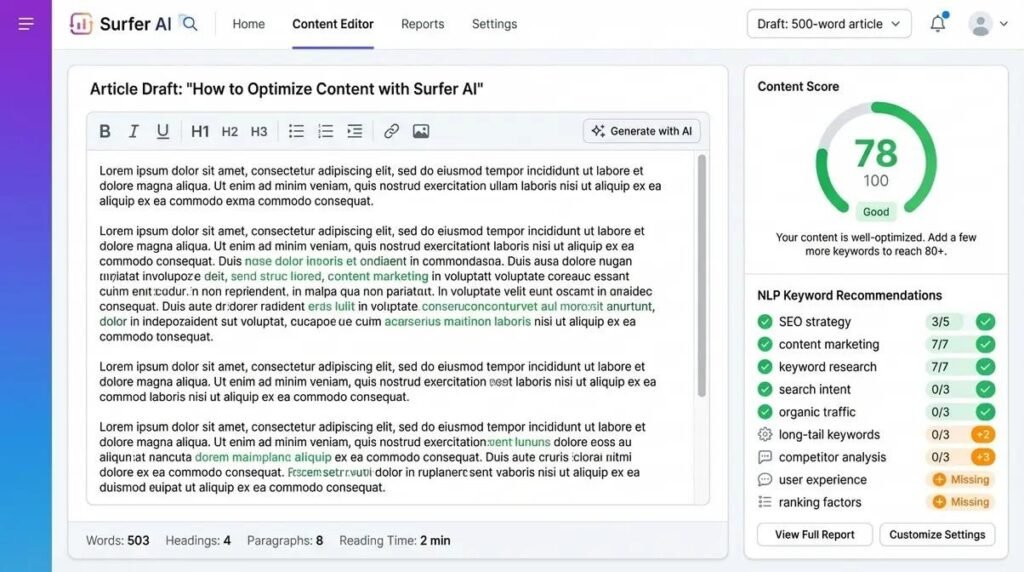
Surfer is one of the more SEO-focused options in this list.
Its Content Editor analyzes search results and provides real-time guidance around topics, keywords, content structure, and other on-page elements. Surfer also has AI writing, an AI assistant called Surfy, internal-link suggestions, plagiarism checking, and a Humanizer.
Its current Discovery plan starts at $49 per month when billed yearly. Standard is $99, Pro is $182, and Peace of Mind is $299 per month on the annual pricing shown by Surfer.
The useful part for an SEO writer is the connection between research and writing.
Instead of drafting an article completely separately from SEO research, you can work inside an editor that gives you search-focused guidance while you write.
Good uses for SEO
- SERP-based content briefs
- On-page content analysis
- AI-assisted article writing
- Topic coverage
- Internal linking
- Content refreshing
- AI search visibility tracking
- Content editing
Surfer is particularly useful if your main job is producing and improving organic-search content.
Best for: SEO writers, agencies, and bloggers who want SEO guidance directly inside the writing workflow.
4. Writesonic
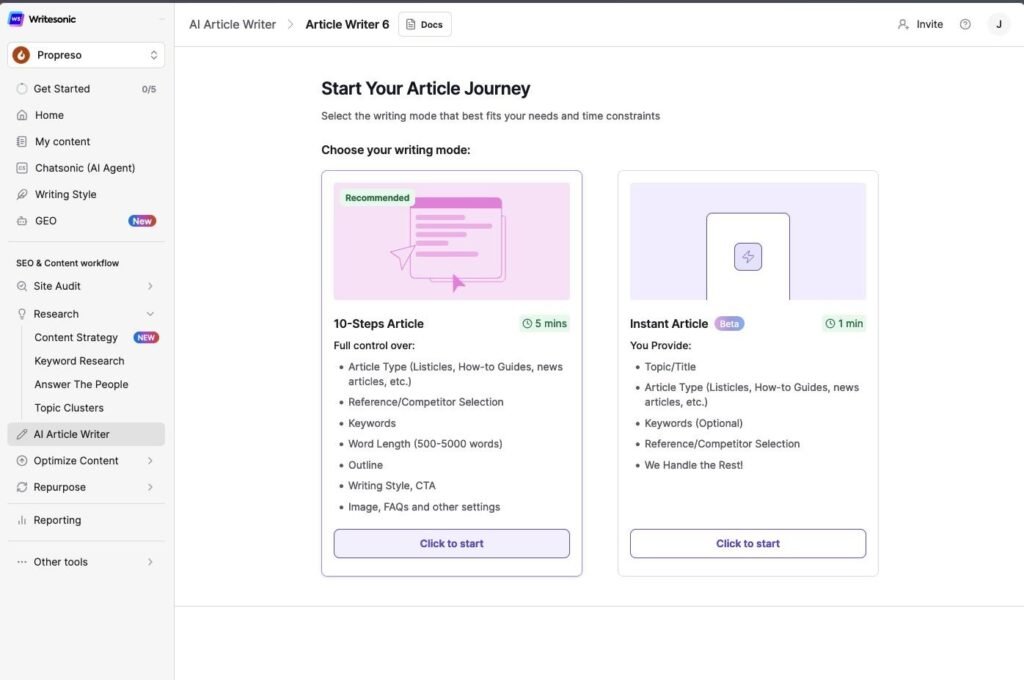
Writesonic has moved well beyond being a basic AI article generator.
Its current platform combines AI writing with SEO tools, site audits, and AI search visibility tracking across platforms such as ChatGPT, Gemini, and Google AI Overviews.
The Starter plan currently starts at $79 per month when billed annually and includes AI articles, site audits, and AI search visibility tracking. Higher plans add more articles, audits, tracked prompts, and AI search features.
That makes Writesonic interesting for publishers who want to look beyond traditional Google rankings.
Good uses for SEO
- AI article creation
- SEO content production
- Site audits
- AI search visibility monitoring
- Content research
- Competitor research
- Content updates
One thing to keep in mind is the price. Writesonic’s current plans are much more expensive than a basic AI chatbot subscription.
Best for: businesses and SEO teams working on both Google search and AI search visibility.
5. Frase
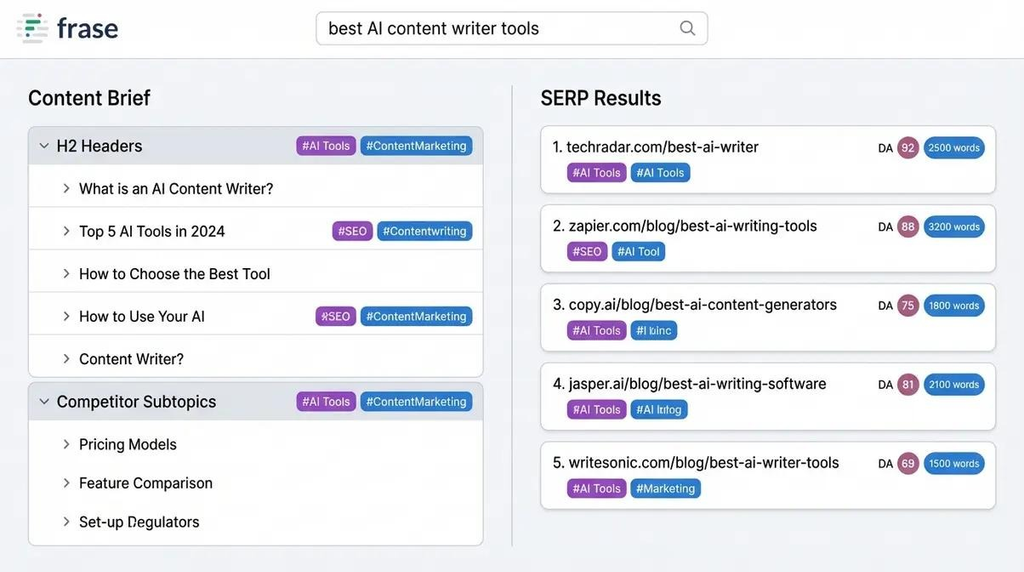
Frase is built around the content research process.
Its current Starter plan costs $39 per month when billed yearly and includes 10 articles and 50 audit pages per month. The Professional plan is $103 per month yearly and increases the limits while adding features such as internal-link suggestions, content calendars, and broader AI visibility tracking.
Frase also connects content research, writing, auditing, and publishing.
It can publish to WordPress, Webflow, Sanity, and Wix, which can be useful if your content workflow already runs through one of those platforms.
Good uses for SEO
- Content briefs
- SERP research
- Article writing
- Content audits
- Internal-link suggestions
- Content decay monitoring
- AI visibility tracking
- WordPress publishing
Frase is worth considering if you want one place to manage the research and writing stages of your content process.
Best for: bloggers, publishers, freelancers, and small SEO teams managing ongoing content.
6. Copy.ai
Copy.ai has a strong marketing focus, but its current product is increasingly centered around workflows and go-to-market operations.
Its Chat plan currently starts at $29 per month for 5 seats when billed monthly, or $24 per month when billed annually. The plan includes unlimited words in Chat and access to OpenAI, Anthropic, and Gemini models.
That multi-model approach can be useful when different tasks work better with different models.
For example, you might use one model for drafting and another for rewriting or analysis without managing several separate subscriptions.
Good uses for SEO
- Blog ideas
- Marketing copy
- Product descriptions
- Social posts
- Email copy
- Content repurposing
- Marketing workflows
Copy.ai makes more sense for people who produce lots of marketing material than for someone who only needs occasional blog posts.
Best for: marketing teams and businesses producing content across several channels.
7. Grammarly
Grammarly sits closer to the editing end of the AI writing process.
Its AI writing assistant can generate and rewrite text, while its traditional writing tools check grammar, spelling, clarity, tone, and other issues. Grammarly currently lists a free plan with 100 AI prompts per month and a Pro plan with 2,000 prompts. Its current Pro pricing page shows $12 per month for individuals.
For SEO content, Grammarly is useful after the first draft exists.
You can use it to catch awkward sentences, clean up grammar, and adjust tone before publishing.
Good uses for SEO
- Proofreading
- Rewriting
- Tone adjustments
- Grammar checks
- Sentence editing
- Final content review
It won’t replace an SEO content platform, but it can be a useful final editing layer.
Best for: writers who already have an SEO workflow and want stronger editing support.
Which AI writing tool should you choose?
The answer depends on where your bottleneck is.
If you’re a blogger
Start with ChatGPT or Frase.
ChatGPT gives you more freedom to build your own workflow. Frase gives you more built-in content research and SEO functionality.
If SEO is your main priority
Look at Surfer.
Its Content Editor is built specifically around search-focused content analysis, and its AI features sit inside that SEO workflow.
If you run a marketing team
Consider Jasper or Copy.ai.
Jasper puts more attention on brand voice and marketing workflows, while Copy.ai focuses heavily on workflows and broader marketing operations.
If you care about AI search visibility
Look at Writesonic, Frase, or Surfer.
These platforms now include features for monitoring how brands and content appear in AI-generated answers, alongside traditional SEO work.
If your main problem is editing
Try Grammarly.
You may already have the writing tool you need. Adding a strong editing layer can be more useful than paying for another full content-generation platform.

How to use AI writing tools for SEO without producing generic content
The tool matters less than the workflow around it.
Start with the search query and the reader’s actual problem. Then give the AI enough information to produce something specific.
For example, instead of:
Write a 2,000-word article about WordPress SEO.
Try:
Write an outline for a beginner-friendly article targeting
"WordPress SEO checklist".

Audience:
Small business owners using WordPress.

Search intent:
They want a practical checklist they can follow before publishing.

Include:
- Technical SEO checks
- On-page SEO
- Internal links
- Image SEO
- Schema
- Mobile usability
- Page speed
- A final publishing checklist

Avoid:
- Generic introductions
- Keyword stuffing
- Repeated explanations
- Claims that aren't supported by evidence

Use short paragraphs and practical examples.
That’s a much better starting point.
Then bring your own experience into the draft.
Add screenshots from your WordPress dashboard. Mention the plugin settings you actually use. Include examples from your own site. Explain where beginners usually get stuck.
AI can help produce the structure. Your experience gives the article a reason to exist.
Don’t let AI decide the SEO strategy by itself
An AI writing tool can suggest keywords and topics, but you still need to check search intent.
Look at the actual search results.
Are people looking for a definition? A tutorial? A comparison? A product? A checklist?
Then check the competing pages and find the information they leave out.
That’s where the human part of SEO still matters.
Use AI for updating old content too
AI writing tools are useful for content refreshes.
Take an older article and ask the tool to identify:
- Outdated information
- Missing subtopics
- Weak introductions
- Repeated sections
- Unclear explanations
- Broken internal-link opportunities
- Questions readers may still have
Then verify every suggested change before publishing it.
This is especially useful for pages that already have search impressions but have started losing traffic.
For WordPress users, AI can also become part of the SEO management workflow. For example, AIOSEO’s MCP feature can connect compatible AI clients with WordPress SEO actions such as reading and updating SEO metadata, checking posts, and managing redirects.
AI writing doesn’t replace SEO fundamentals
You still need a good keyword target.
You still need useful information.
You still need internal links, sensible titles, strong headings, good page structure, and a site that works well for visitors.
And you need to check factual claims before publishing.
A 2,000-word AI article that says the same thing as 20 competing pages won’t automatically rank because it was written by AI.
The quality of the research, usefulness of the information, search intent match, and your site’s overall SEO still matter.
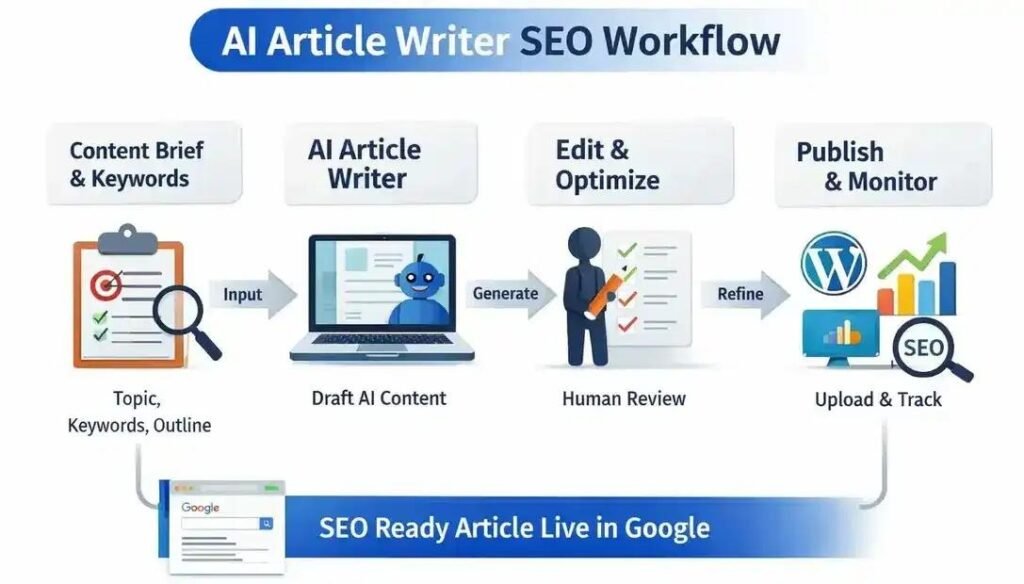
My practical AI writing workflow for SEO
For a small blog, I’d keep the workflow fairly simple:
1. Research the keyword
Understand what the searcher wants and review the current results.
2. Build the outline
Use ChatGPT, Claude, Frase, or another research tool to identify useful subtopics.
3. Add your own notes
Put your experience, examples, screenshots, data, and opinions into the outline.
4. Write the draft
Use an AI writing tool for sections where it genuinely saves time.
5. Edit hard
Delete repetition. Fix vague claims. Replace generic examples with real ones.
6. Run an SEO check
Use a tool such as Surfer or Frase if you want additional content analysis.
7. Fact-check
Verify statistics, product features, prices, dates, and claims.
8. Add internal links
Connect the new article to relevant pages on your site.
9. Add original visuals
Screenshots, diagrams, examples, and useful images can make the page much more useful.
10. Publish and monitor
Watch impressions, clicks, rankings, and engagement after the page has had time to collect data.
Final thoughts
The best AI writing tools are the ones that fit the job you’re actually trying to do.
A general assistant such as ChatGPT gives you a flexible writing partner. Surfer and Frase put more SEO research directly into the content workflow. Jasper and Copy.ai focus heavily on marketing teams. Writesonic combines content production with AI search visibility. Grammarly is useful when the draft already exists and needs editing.
For a small SEO blog, I’d rather have one AI writing tool plus a clear editorial process than a stack of six subscriptions.
Use AI to reduce repetitive work. Keep the research, judgment, examples, and final editing under human control.
FAQS
What are the best AI writing tools for SEO?
The right tool depends on the part of SEO content creation you need help with. ChatGPT is useful for research, outlines, drafting, and editing, while Surfer and Frase focus more heavily on SEO content analysis. Jasper and Copy.ai are geared toward marketing workflows, and Grammarly is useful for editing.
Can AI writing tools do keyword research?
Some AI writing platforms include keyword research or topic research features. However, you should still verify important keyword information with an SEO research tool and check the actual search results before choosing a topic.
Should I use AI to write my entire SEO article?
You can use AI to create a first draft, but the finished article should go through human review. Add your own examples, experience, screenshots, research, and useful details that make the page more specific to your audience.
Do AI writing tools replace SEO tools?
Usually, no. An AI writing tool can help create and edit content, while dedicated SEO tools can provide keyword data, SERP analysis, technical information, backlink data, or content analysis. Some platforms combine several of these functions.
How can I use AI writing tools without making my content sound generic?
Give the tool specific information about the audience, search intent, topic, examples, and your preferred writing style. Then edit the draft yourself. Adding original examples, screenshots, firsthand observations, and properly checked information makes the final article more useful.