
On-Page vs Off-Page SEO: Stop Believing These Myths
On-Page vs Off-Page SEO is not a competition where one side wins and the other loses. On-page SEO optimizes everything you control on your own website so search engines and users clearly understand what a page is about and why it is useful.
Off-page SEO builds the external signals of trust and authority that tell Google other people value your site. Both are required for competitive rankings in 2026, yet persistent myths still push site owners to over-invest in one while neglecting the other.
Example
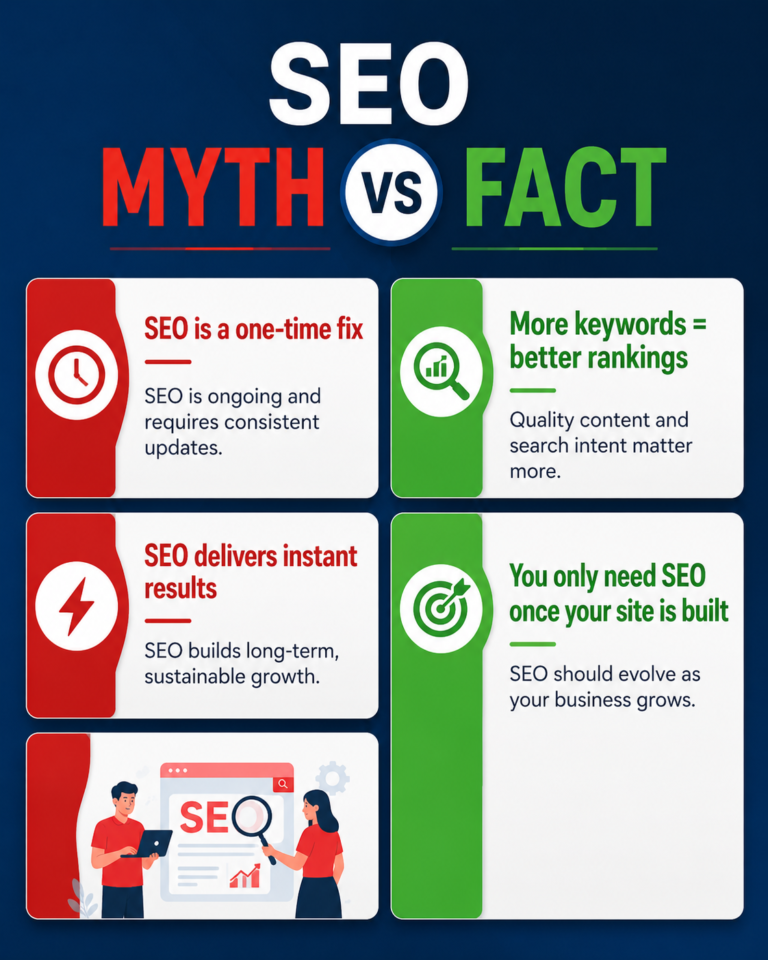
Many businesses pour months into perfect title tags and content while ignoring reputation signals, or chase backlinks before the pages those links point to are even useful. The result is stalled rankings, wasted budgets, and frustration.
This guide clears up the real differences, busts the most damaging myths, and shows how the two sides reinforce each other so you can allocate effort wisely.
Understanding On-Page vs Off-Page SEO Clearly
On-page SEO covers every element you can edit directly on your site. This includes the content itself, heading structure, title tags, meta descriptions, internal links, image alt text, page speed, mobile usability, and structured data. Its job is to make a page relevant, easy to crawl, and satisfying for the searcher.
Off-page SEO happens outside your domain. The main drivers are quality backlinks, unlinked brand mentions, digital PR, reviews, and other third-party signals that demonstrate authority and trustworthiness. You influence these signals through outreach, relationships, and creating material worth linking to, but you do not control them completely.
A simple way to remember the distinction: On-page SEO is what your website says about itself. Off-page SEO is what the rest of the internet says about your website. Google needs both signals. Relevance without reputation rarely reaches page one for competitive terms. Reputation without relevance sends traffic to pages that disappoint users and quickly lose ground.
Technical SEO (crawlability, indexing, Core Web Vitals, site architecture) sits closest to on-page because the fixes live on your servers and in your code. Some practitioners separate it, yet the practical effect is the same: it must be solid before either content or link efforts deliver full value.
Key Differences in On-Page vs Off-Page SEO
| Factor | On-Page SEO | Off-Page SEO |
|---|---|---|
| Location | On your website | Outside your website |
| Primary goal | Relevance and user experience | Authority and trust |
| Level of control | Full | Partial |
| Typical time to impact | Weeks to a few months | Months to a year |
| Main levers | Content quality, structure, speed, internal links | Backlinks, mentions, PR, reviews |
| Risk level | Low when guidelines are followed | Higher if spammy tactics are used |
| Best first priority | New or under-optimized sites | Sites with solid foundations |
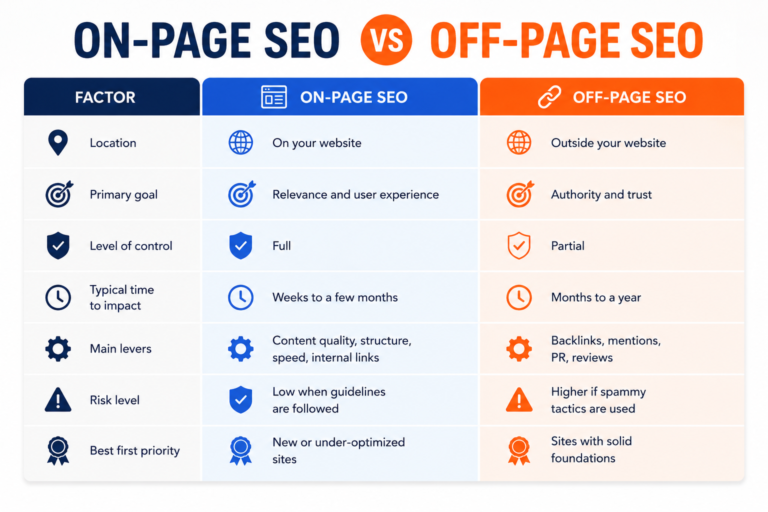
On-page changes can be measured relatively quickly in Google Search Console through impressions, clicks, and ranking shifts for targeted queries. Off-page progress shows up more slowly in referring domains, brand search volume, and overall domain strength metrics from tools such as Ahrefs or Semrush.
Neither side is optional for most competitive keywords. Low-competition or highly niche queries sometimes rank on strong on-page work alone. Almost everything else needs external validation.
Common Myths About On-Page vs Off-Page SEO That Still Cause Damage
Several outdated beliefs continue to waste time and money. Here are the most persistent ones and the reality behind them.
Myth 1: Great content alone is enough to rank.
Helpful content is essential, but it is not sufficient. Without clear structure, proper internal linking, and technical accessibility, even excellent writing can remain invisible.
Search engines must be able to understand and trust the page. Content that never gets crawled or that fails to match intent will not rank, no matter how insightful it is.
Myth 2: Backlinks are the only thing that matters.
Backlinks remain powerful authority signals, yet they cannot rescue a page that fails to satisfy search intent or loads slowly on mobile.
Links pointing to thin, poorly structured, or off-topic content deliver limited value and can even look unnatural. Quality content makes high-value links easier to earn and more likely to stick.
Myth 3: You need hundreds or thousands of links.
Volume is far less important than relevance and authority. A handful of editorial links from trusted sites in your niche usually outperform large numbers of low-quality or irrelevant links. Google’s systems have grown better at discounting manipulative patterns.
Myth 4: Social shares and social signals are direct ranking factors.
Shares themselves do not function as ranking signals. However, content that spreads widely often attracts natural backlinks, brand mentions, and increased branded searches, all of which can help. Treating social media purely as a ranking lever leads to the wrong tactics.
Myth 5: Guest posting is dead or always spammy.
Low-quality, mass guest posting for links is risky and often ineffective. Thoughtful, relevant contributions to respected publications in your industry still work when the content genuinely adds value and the link is editorially given.
Myth 6: High domain authority guarantees you will outrank competitors.
Domain-level metrics from third-party tools correlate with rankings but do not cause them. A high-authority site with weak on-page relevance or poor user experience can still lose to a more focused, better-optimized lower-authority page. On-page work and topical expertise remain decisive.
Myth 7: You can choose one side and ignore the other.
This is the most costly myth. Sites that perfect on-page elements but never build reputation stall. Sites that chase links while leaving content and technical foundations weak waste the authority they earn. Balanced progress produces the strongest long-term results.
How On-Page and Off-Page SEO Work Together
Strong on-page SEO makes off-page efforts more effective. When a page clearly matches intent, loads quickly, and offers unique value, other sites are more willing to link to it. Internal linking then distributes the authority those external links bring to other important pages on your site.
Conversely, off-page authority can lift an entire section of a well-structured site. Once Google trusts the domain, pages that already demonstrate relevance tend to rank more easily and more stably.
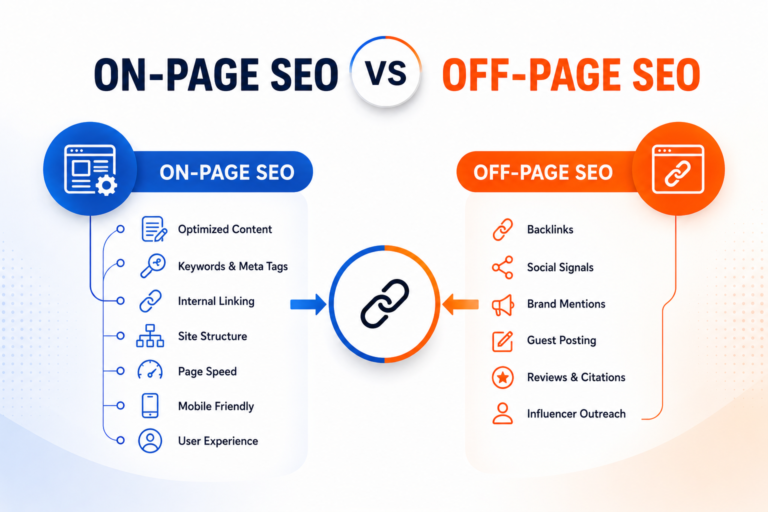
A practical sequence for most sites looks like this:
- Fix technical foundations and core on-page elements so pages are crawlable, fast, and intent-matched.
- Build a coherent internal linking structure so authority can flow.
- Create content worth linking to and begin ethical outreach or digital PR.
- Maintain both sides continuously as algorithms, competitors, and user expectations evolve.
Newer sites usually benefit from heavier early investment in on-page work (roughly 70-80 percent of effort). Sites with solid content that still struggle on page two or three often need a stronger off-page push. Sites stuck with mixed signals benefit from roughly equal attention.
Practical Steps for Better On-Page vs Off-Page SEO Balance
Start with an honest audit. Check Google Search Console for crawl and indexing issues, Core Web Vitals, and query performance. Review a sample of top pages for title tags, heading hierarchy, content depth against the current top results, and internal links. Use a crawler such as Screaming Frog for technical gaps.
For content, match search intent first. Look at what currently ranks and what format users engage with. Write for humans while using clear language, descriptive headings, and natural keyword placement. Avoid any form of stuffing. Add schema where it helps (FAQ, HowTo, Article, etc.) so search engines and AI systems can parse the page more easily.
On the off-page side, prioritize relevance and editorial quality over volume. Digital PR, original research, useful tools, and genuine relationships tend to produce the most durable links. Monitor brand mentions and convert unlinked ones where appropriate. Encourage authentic reviews on relevant platforms if you have a local or product component.
Track progress with a small set of meaningful metrics rather than vanity numbers: ranking and traffic for priority pages, referring domains from relevant sites, brand search volume, and conversion rates from organic traffic. Adjust the balance of effort every few months based on what the data shows.
Internal linking opportunities often appear when you expand topic clusters. A strong guide on keyword research can naturally point to related pieces on content optimization, technical audits, or link-building tactics, strengthening both relevance and authority flow across the site.
Conclusion
On-Page vs Off-Page SEO works best when treated as two complementary halves of the same system rather than rival strategies. On-page work makes your pages clear, useful, and technically sound. Off-page work builds the external proof that those pages deserve attention. The myths that still circulate—content alone is enough, links alone are enough, volume beats quality, one side can be ignored—lead to unbalanced effort and slower progress.
Focus first on making every important page relevant and easy to use. Then earn genuine authority signals through useful content and ethical outreach. Review the balance regularly against real performance data. When both sides move together, rankings become more stable and traffic more valuable.
If your site currently leans too far in one direction, start with a focused audit of the weaker side this month. Small, consistent improvements compound faster than occasional big pushes that ignore half the equation.
FAQs
Which is more important, on-page or off-page SEO?
Neither works well in isolation for competitive terms. On-page establishes relevance; off-page establishes trust. Most sites need both, with on-page usually coming first.
Can a site rank without backlinks?
Yes, for low-competition or highly specific queries. For most commercial or competitive informational terms, some form of external authority is usually required.
Is technical SEO part of on-page or off-page?
It is closest to on-page because the changes live on your site. Crawlability, speed, mobile-friendliness, and structured data all fall under elements you control directly.
How long does each side take to show results?
On-page improvements can influence impressions and rankings within weeks once pages are re-crawled. Meaningful off-page impact typically takes several months as links are acquired and authority is evaluated.
Should new websites focus only on on-page SEO at first?
Heavy emphasis on on-page and technical foundations is smart. Light off-page activity (brand mentions, a few high-quality placements) can still help discovery, but the priority should be making the site itself strong.
Neither works well in isolation for competitive terms. On-page establishes relevance; off-page establishes trust. Most sites need both, with on-page usually coming first.
Yes, for low-competition or highly specific queries. For most commercial or competitive informational terms, some form of external authority is usually required.
It is closest to on-page because the changes live on your site. Crawlability, speed, mobile-friendliness, and structured data all fall under elements you control directly.
On-page improvements can influence impressions and rankings within weeks once pages are re-crawled. Meaningful off-page impact typically takes several months as links are acquired and authority is evaluated.
Heavy emphasis on on-page and technical foundations is smart. Light off-page activity (brand mentions, a few high-quality placements) can still help discovery, but the priority should be making the site itself strong.