
SEO copywriting sits in the middle of two jobs.
You need to write something people actually want to read, while making it clear enough for search engines to understand what the page is about.
That sounds simple. It isn’t.
A page can rank well and still get ignored. Another page can attract plenty of clicks but fail to turn visitors into customers.
Good SEO copywriting handles both sides.
What is SEO copywriting?
SEO copywriting is the process of creating content that satisfies a searcher’s intent while using language and structure that help search engines understand the page.
Think about someone searching for “best running shoes for beginners.”
They probably don’t want a 2,000-word history of running shoes. They want useful recommendations, comparisons, prices, pros and cons, and enough information to make a decision.
Your copy needs to match that expectation.
Keywords still matter, but they’re only one part of the job. Your content also needs the right search intent, clear structure, useful information, and a reason for the reader to keep going.
SEO copywriting vs. regular copywriting
Traditional copywriting usually focuses on persuasion.
SEO copywriting has another layer: discoverability.
You’re writing for people who may find the page through Google, Bing, social platforms, or other search systems. That means your copy has to answer the query clearly enough for the reader and search engine to understand its purpose.
The best approach is to write for the reader first, then make the page easy for search engines to interpret.
12 SEO copywriting tips that actually help
1. Start with search intent
Before writing a single paragraph, figure out what the searcher wants.
Search intent usually falls into a few common categories:
- Informational: the person wants to learn something.
- Navigational: the person wants to find a specific website or page.
- Commercial: the person is researching before buying.
- Transactional: the person is ready to take an action or make a purchase.
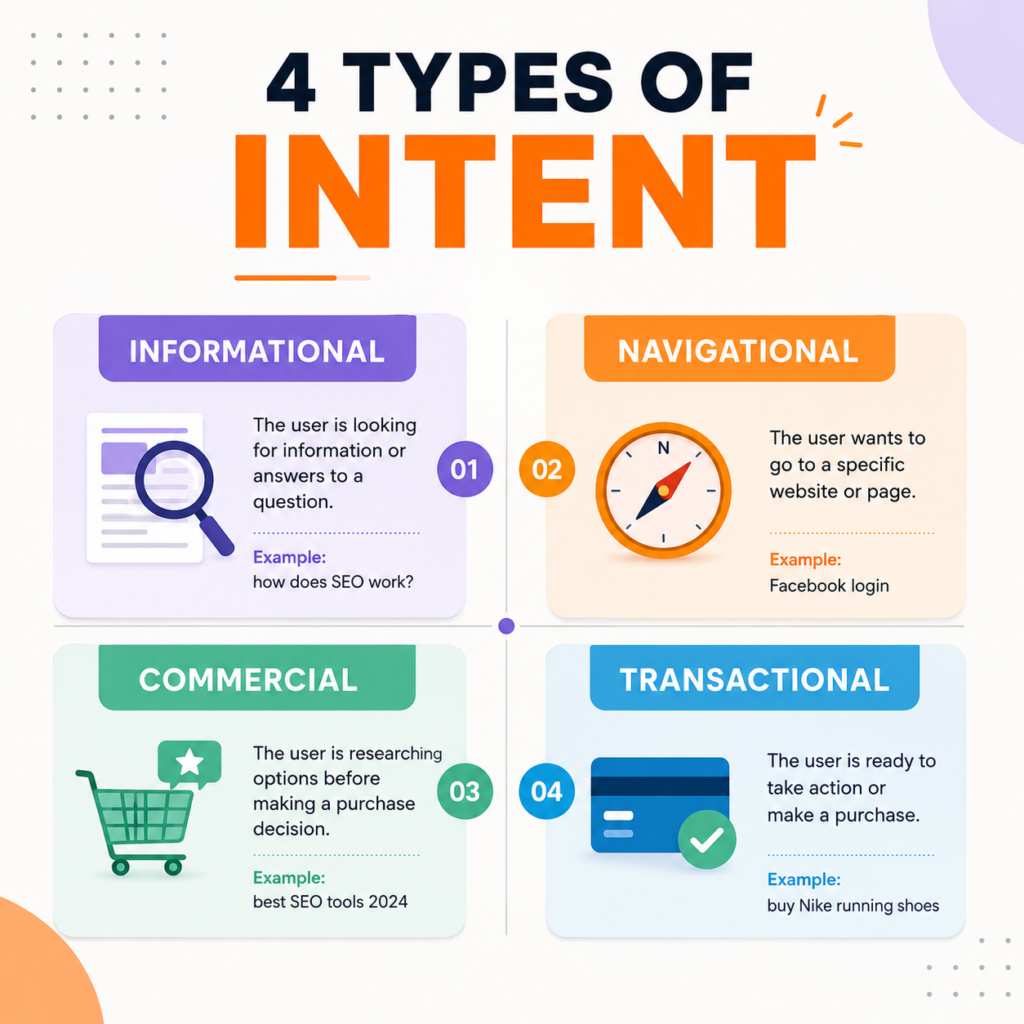
For example, someone searching “what is content pruning” probably wants an explanation.
Someone searching “best content pruning tools” has a different goal.
The keyword alone doesn’t tell you enough. Look at the actual search results and study the pages Google is already ranking.
2. Choose one primary topic
Give every page a clear job.
If you’re writing about SEO copywriting, don’t suddenly turn the article into a complete technical SEO guide, a backlink tutorial, and a keyword research course.
Related topics are useful when they help answer the main query.
Unrelated topics dilute the page.
A focused article is easier for readers to follow and easier for search engines to categorize.
3. Use your main keyword naturally
Your primary keyword should appear where it makes sense.
Good places can include:
- Page title
- Main heading
- Introduction
- Relevant subheadings
- Body copy
- URL
- Image alt text when the image genuinely describes the topic
But don’t force the keyword into every paragraph.
If you write:
SEO copywriting helps businesses with SEO copywriting because SEO copywriting is important for SEO copywriting…
the reader will notice immediately.
Write naturally. Use related terms when they genuinely fit.
4. Write headlines that earn the click
Your headline has one job before anything else: make the right person want to read.
Compare:
SEO Copywriting Tips
with:
12 SEO Copywriting Tips to Get More Clicks and Keep Readers Engaged
The second gives the reader more information about what they’ll get.
You can use numbers, a specific benefit, a clear audience, or a strong angle.
Just make sure the headline matches the actual content. A clever headline that makes a promise the article doesn’t deliver will hurt trust.
5. Make the introduction useful
Skip the long warm-up.
Tell the reader what the page is about and get to the first useful point quickly.
For example:
Your page can rank on Google’s first page and still generate very few clicks. The problem might be the copy, not the ranking. Here’s how to write SEO content that gets attention and gives readers a reason to stay.
That’s enough.
The reader knows what problem you’re addressing and what they can expect.
6. Structure the page for scanning
Most people don’t read online content word by word.
They scan.
Use:
- Short paragraphs
- Descriptive headings
- Bullet points
- Numbered steps
- Tables when comparisons make sense
- Bold text for genuinely important details
Don’t turn every sentence into a bullet point, though. That creates another kind of clutter.
Your structure should help someone find the exact answer they’re looking for.
7. Put the important information early
Don’t hide the answer at the bottom of a 2,500-word article.
If someone searches “how long should an SEO title be?”, answer the question near the beginning.
Then explain the reasoning, examples, exceptions, and related details afterward.
This works for readers because they get their answer quickly.
It also gives search engines clearer signals about what the page actually answers.
8. Use examples instead of vague advice
“Write engaging content” isn’t very useful advice.
Show the reader what that means.
Weak:
Use compelling copy to encourage readers to take action.
Better:
Instead of writing “Contact us for more information,” try “Get your free SEO audit and see which pages are losing traffic.”
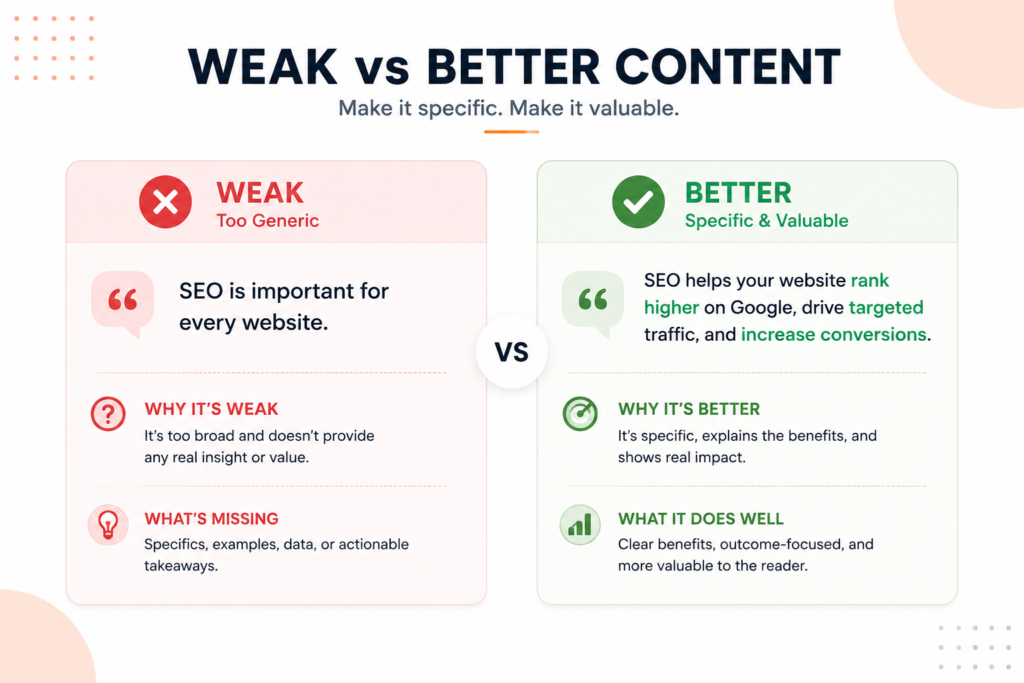
The second example gives the reader something concrete to work with.
Whenever you make a writing recommendation, show the before and after when possible.
9. Match the language your audience uses
Your audience doesn’t necessarily use industry terminology.
A beginner searching for “how to fix broken links” may understand “broken links” but have no idea what “HTTP status codes” means.
You can introduce technical terms when they’re useful. Explain them in plain language first.
This also helps you discover related language people use around your topic.
Read search suggestions, People Also Ask questions, Reddit discussions, forums, product reviews, and comments. They can reveal the exact problems and phrases your audience cares about.
10. Improve your calls to action
SEO copywriting doesn’t end when someone reaches the bottom of the page.
Decide what you want the reader to do next.
Maybe you want them to:
- Read another article
- Download a resource
- Subscribe to your newsletter
- Request a service
- Buy a product
- Book a consultation
Make the next step obvious.
Instead of:
Click here to learn more.
Try:
Download the free technical SEO checklist.
The reader knows exactly what happens next.
11. Add internal links where they help
Internal links connect related pages on your website.
They help readers discover more useful information and help search engines understand the relationships between your pages.
Suppose you’re writing an article about keyword research.
You could naturally link to related pages about:
- Search intent
- Keyword clustering
- Long-tail keywords
- Content briefs
- On-page SEO
The key word is naturally.
Don’t add 30 internal links just because you can. Link when another page genuinely helps the reader.
12. Edit for humans before publishing
Your first draft will probably be longer than it needs to be.
That’s normal.
Go back through it and remove:
- Repeated ideas
- Empty introductions
- Unnecessary adjectives
- Long sentences
- Weak claims
- Generic statements
- Sections that don’t answer the searcher’s question
Read the article out loud.
If a sentence sounds awkward when you say it, rewrite it.
Good copy usually gets tighter during editing.
How to write an SEO-friendly article from scratch
Here’s a simple workflow you can repeat.
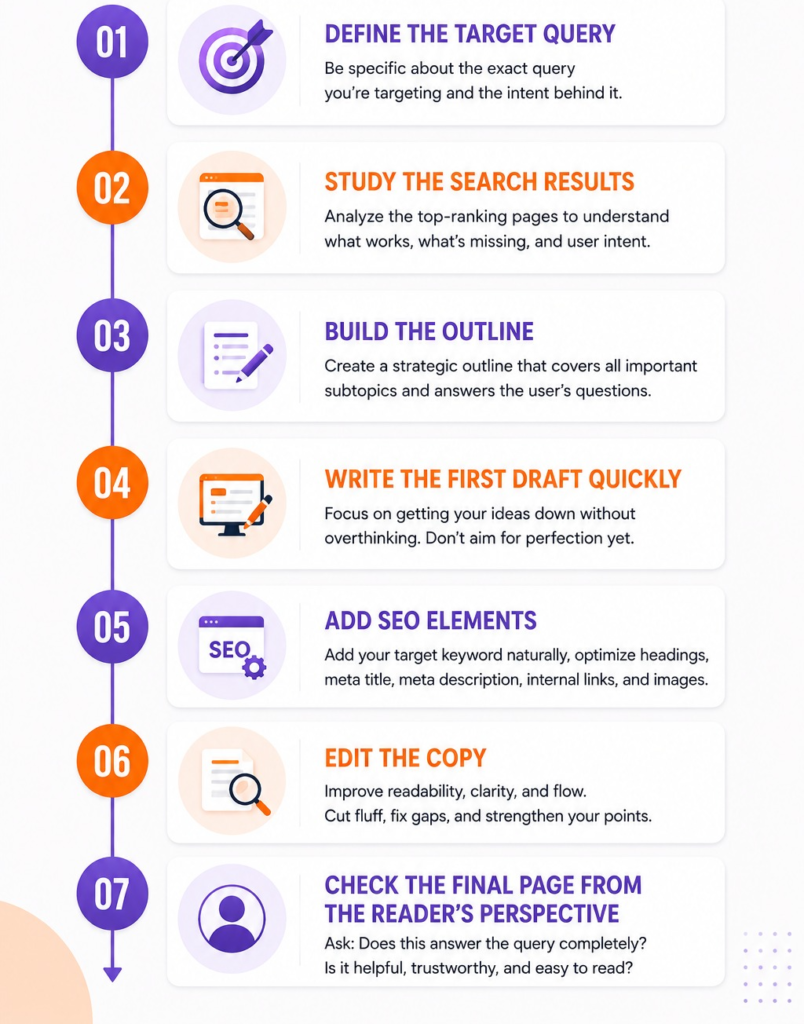
Step 1: Define the target query
Choose the primary keyword or search topic.
Don’t start writing until you know what you’re trying to rank for.
Step 2: Study the search results
Look at the current top-ranking pages.
Ask:
- What questions do they answer?
- How are the articles structured?
- What type of content is ranking?
- What information appears repeatedly?
- What seems to be missing?
You’re looking for the searcher’s expectations, not a template to copy.
Step 3: Build the outline
Create your H2s and H3s around the questions your reader needs answered.
Put the most important information where it makes sense for the reader.
Step 4: Write the first draft quickly
Don’t stop every 2 minutes to edit a sentence.
Get the ideas down first.
You can fix awkward wording later.
Step 5: Add SEO elements
Review your:
- Title
- URL
- H1
- Subheadings
- Meta description
- Internal links
- Images and alt text
- Relevant keywords and related terms
These elements should support the page rather than distract from it.
Step 6: Edit the copy
Cut anything that doesn’t earn its place.
Then check whether every major section actually answers a question or solves a problem.
Step 7: Check the final page from the reader’s perspective
Ask yourself:
If I searched this query, would this page give me what I came for?
If the answer is yes, you’re heading in the right direction.
Common SEO copywriting mistakes
Keyword stuffing
Repeating a keyword doesn’t make a page more relevant.
It usually makes the writing worse.
Writing for a word count
A 1,500-word article isn’t automatically better than a 700-word article.
If the query can be answered properly in 700 words, stop at 700.
Copying competitor structure too closely
Competitor research is useful.
Copying their headings, examples, and wording creates thin content with little reason for someone to choose your page.
Use the search results to understand the topic. Then bring your own experience, examples, explanations, or data.
Ignoring the first screen
When someone lands on your page, they should quickly understand:
What is this page about?
Is it relevant to me?
Why should I continue reading?
Your title, introduction, headings, and opening content need to answer those questions quickly.
Writing before understanding the audience
You can have perfect grammar and still write useless content.
Know who you’re writing for.
A beginner needs different explanations from an experienced SEO professional.
A simple SEO copywriting checklist
Before publishing, check these 12 things:
- Search intent is clear
- The page has one main topic
- The primary keyword is used naturally
- The title accurately describes the page
- The introduction gets to the point
- Headings make the article easy to scan
- Examples support important advice
- The language matches the audience
- Internal links are relevant
- The CTA is clear
- Repetition has been removed
- The final draft sounds like a person wrote it
Final thought
SEO copywriting is a writing skill with an SEO layer.
You need to understand what people search for, why they search for it, and what information will actually help them.
Then write clearly.
Use the keyword where it belongs. Structure the page so people can scan it. Give real examples. Cut the fluff.
That’s the part that makes SEO copywriting work.
FAQs
What is SEO copywriting?
SEO copywriting is the process of creating valuable, engaging content that satisfies a user’s search intent while utilizing structure and keywords to help search engines like Google understand and rank the page.
What is the difference between SEO copywriting and regular copywriting?
Traditional copywriting focuses entirely on persuasion and conversion. SEO copywriting adds a layer of discoverability, ensuring the content is optimized for search engines so users can find it organically through platforms like Google.
How do I choose the right keywords for SEO copywriting?
Start by researching what your target audience is searching for using tools like Ahrefs, Moz, or Ubersuggest. Look at the search intent behind the keyword (informational, commercial, navigational, or transactional) and analyze the top-ranking pages to see what kind of content format Google expects.
How many times should I use my primary keyword?
There is no fixed percentage or magic number. Your primary keyword should be used naturally in essential places like the page title, main heading (H1), introduction, a few subheadings, and the URL, but never forced to the point where it disrupts readability.
Why is search intent important in SEO copywriting?
Search intent tells you why someone is typing a query into Google. If a user wants a quick product comparison, a 3,000-word historical essay will fail to keep their attention. Matching your content format to search intent ensures visitors get what they came for, reducing bounce rates.