
If you’ve started hearing about llms.txt, llms-full.txt, and AI search optimization, you may be wondering what these files actually do and whether your website needs one.
The short answer is that llms-full.txt is an emerging convention for giving AI systems a larger, consolidated version of a website’s useful content in Markdown format. It is commonly associated with the llms.txt ecosystem, particularly documentation websites.
There’s an important distinction, though: llms.txt has a published proposal and format, while llms-full.txt is not part of the current official llmstxt.org v2 specification. Some platforms and website owners use llms-full.txt as an expanded companion file that places the content of linked pages into one document.
That difference matters if you’re deciding whether to create one for your SEO website.
Table of Contents
What is llms-full.txt?
llms-full.txt is a large Markdown file that can contain the full text of multiple pages from a website in one place.
The idea is simple. Instead of an AI system discovering an llms.txt file, following several links, downloading individual pages, and extracting their useful content, a full-text file can put much of that information into one document.
For example, a documentation website might have:
example.com/
├── llms.txt
├── llms-full.txt
├── docs/
│   ├── getting-started/
│   ├── installation/
│   ├── api/
│   └── tutorials/
The llms.txt file can act as a concise guide to the website.
The llms-full.txt file can then contain the actual content from many of the linked resources.
This approach is particularly useful for websites with large documentation collections where an AI agent may need information from several related pages.
Is llms-full.txt part of the official llms.txt specification?
This is where much of the confusion comes from.
The current llmstxt.org proposal defines llms.txt as the main file. It describes a website and provides links to useful, LLM-friendly resources. The proposal also recommends clean Markdown versions of relevant pages.
llms-full.txt, however, is used by some implementations as an expanded companion file.
For example, the Answer.AI llms-txt project describes generated context files such as llms-ctx-full.txt, which include the linked content. This shows that full-context files are part of the wider tooling around the proposal, rather than being a required part of the core llms.txt format.
So it’s better to think about the two files like this:
| File | Main purpose |
|---|---|
llms.txt | Gives AI systems a concise overview and links to useful resources |
llms-full.txt | Common companion convention containing expanded or full page content |
sitemap.xml | Helps search engines discover a site’s URLs |
robots.txt | Provides crawler access instructions |
The exact implementation of llms-full.txt can vary because it isn’t currently a required part of the llmstxt.org v2 format.
How does llms-full.txt work?
Imagine you run a WordPress website about SEO.
You have 50 useful articles covering:
- Technical SEO
- Keyword research
- WordPress SEO
- Internal linking
- Schema markup
- AI search
- Content optimization
An AI system could potentially access individual pages when it needs information.
A full-context file takes a different approach. It can combine selected page content into one Markdown document.
A simplified example might look like this:
# MaryamSEO

> Practical SEO guidance for website owners, bloggers, and small businesses.

## WordPress SEO

### WordPress SEO Setup Guide

Full content from the selected page...

### WordPress Technical SEO

Full content from the selected page...

## Keyword Research

### Keyword Research Guide

Full content from the selected page...
The result is a single resource containing a large amount of useful context.
That can make content retrieval simpler for systems that are designed to consume such files.
llms.txt vs llms-full.txt
The easiest way to understand the difference is to think of llms.txt as a map and a full-context file as a larger collection of the underlying material.
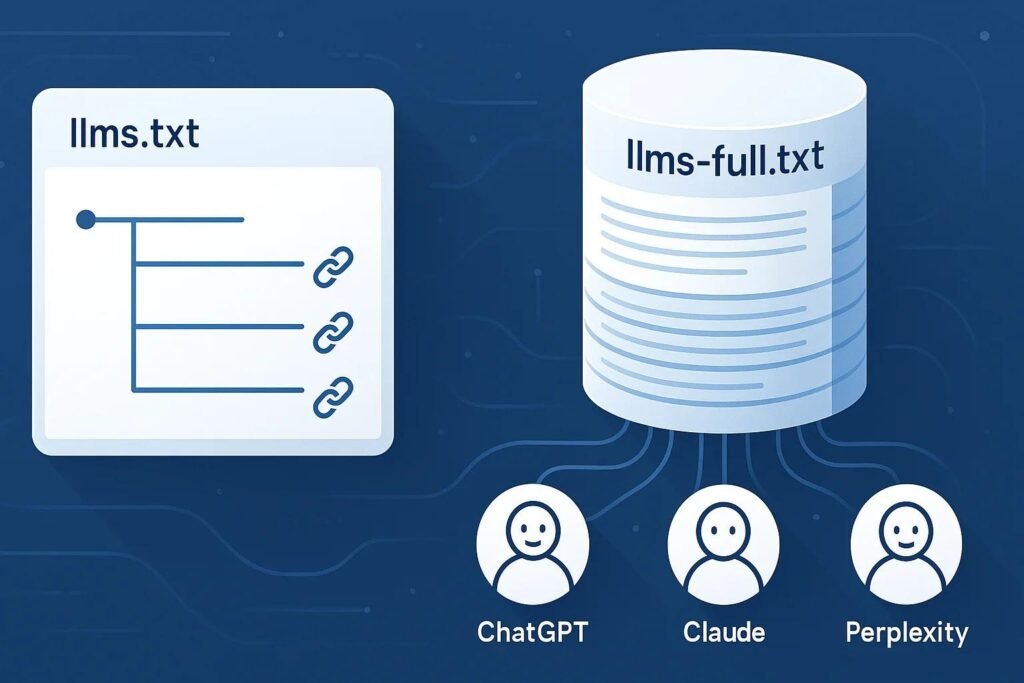
llms.txt
The main file is designed to stay relatively concise.
It can contain:
- The website name
- A short description
- Important background information
- Sections grouping useful resources
- Links to relevant pages
- Short descriptions of those pages
The llmstxt.org proposal specifies an H1 title as the only required section, followed by an optional summary, additional information, and H2 sections containing lists of linked resources.
llms-full.txt
A full-context file can contain the actual content from selected pages.
That means it can become much larger.
For a documentation website, this might include the contents of:
- Tutorials
- API documentation
- Setup guides
- Reference pages
- Examples
- Troubleshooting documentation
The purpose is to reduce the need to fetch each page individually when the consuming system supports this format.
Why was llms-full.txt created?
The broader llms.txt idea exists because websites are designed primarily for people.
A normal HTML page can contain:
- Navigation menus
- Headers and footers
- Advertisements
- JavaScript
- Cookie notices
- Related-content widgets
- Comments
- Other interface elements
An AI agent interested in a specific technical answer may only need the actual article or documentation.
The llms.txt proposal argues that a concise, accessible Markdown representation can make useful information easier for agents to locate and process.
A full-context file takes this idea further by putting the content itself into one resource.
Does llms-full.txt help Google rankings?
You should not create llms-full.txt expecting a Google ranking boost.
Google Search’s current documentation explicitly says that llms.txt files aren’t required for Google Search and don’t provide a positive or negative effect on Search visibility or rankings. Google says site owners can maintain these files for other services or systems that use them.
This is one of the most important points for SEOs.
Creating a full-context file should therefore be treated as an AI-access and content-distribution experiment, not as a replacement for traditional SEO.
Your normal SEO work still matters:
- Helpful content
- Crawlable pages
- Good internal linking
- Clear site structure
- Strong page titles
- Descriptive URLs
- Relevant structured data
- Good technical SEO
- Original information
- Good user experience
Google’s guidance on generative AI search also continues to emphasize established SEO practices rather than requiring special AI files.
Does llms-full.txt help ChatGPT or other AI systems?
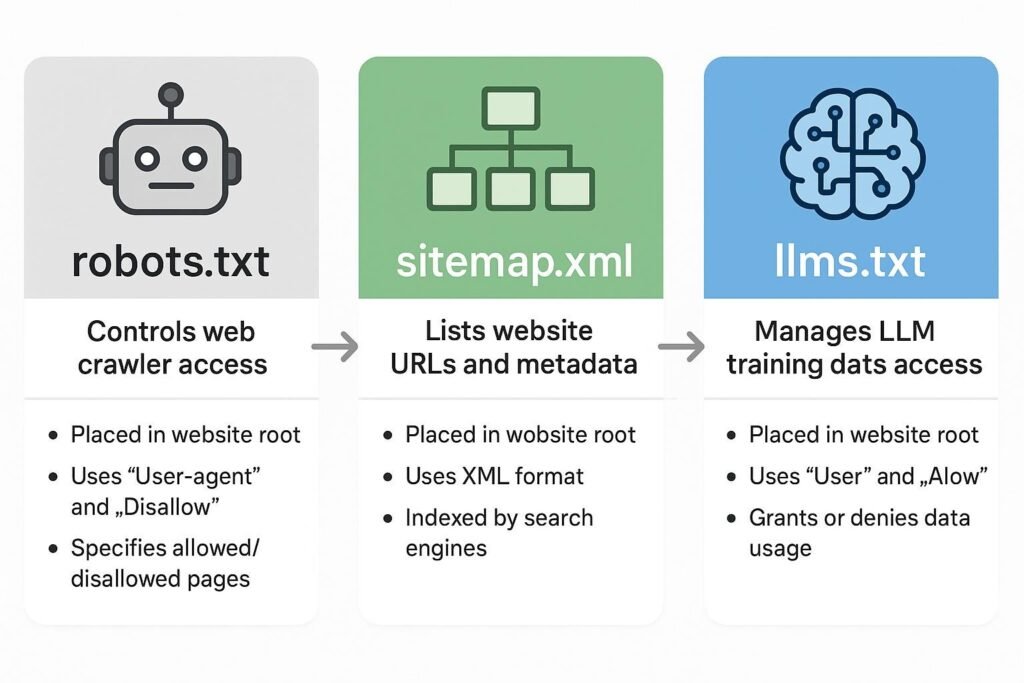
It depends on whether a particular AI system, crawler, agent, or tool actually uses the file.
There is no universal rule saying every AI system will automatically read /llms-full.txt.
That distinction is easy to miss.
Publishing the file does not guarantee that:
- ChatGPT will read it
- Google will use it
- An AI answer will cite your website
- Your content will appear in an AI overview
- Your website will receive more traffic
The file is simply another machine-readable resource that some systems may choose to consume.
The llms.txt proposal itself describes its expected use primarily around agents and on-demand information retrieval.
Who can benefit from llms-full.txt?
A full-context file makes the most sense for websites with substantial, connected information.
Documentation websites
This is probably the clearest use case.
A software company might have hundreds of documentation pages. Putting selected documentation into a full-context resource can give an agent access to a larger body of related information.
Developer resources
API documentation, code examples, configuration instructions, and technical references can be easier to consume when related information is available in Markdown.
Educational websites
A course website could potentially organize related lessons, definitions, and reference material into a machine-readable collection.
Large knowledge websites
Websites with closely connected information may also experiment with full-context files.
For a small blog with 20 unrelated posts, the benefit may be much less obvious.
Should an SEO blog create llms-full.txt?
There isn’t a universal requirement to do so.
For a site such as an SEO blog, I’d first focus on making the actual website content strong and easy to understand.
If you want to experiment with AI-friendly publishing, llms.txt is the clearer starting point because it has a defined proposal and format.
A full-context file can be considered later if you have:
- A large collection of related articles
- Strong topical organization
- Clean Markdown versions of your content
- A reliable way to generate and update the file
- A clear reason for making the content available in this format
The key issue is maintenance.
If your website publishes 5 new articles every month, a manually maintained full-context file can quickly become outdated.
How to create an llms-full.txt file
If you decide to experiment with one, start with a small, controlled set of high-quality content.
Step 1: Create your llms.txt file
Start by creating the standard llms.txt file at the appropriate location, usually:
https://example.com/llms.txt
The proposed format uses Markdown.
A basic example:
# Example SEO Website

> Practical SEO guidance for website owners and small businesses.

## SEO Guides

- [Technical SEO Guide](https://example.com/technical-seo/): A practical guide to technical SEO.
- [Keyword Research Guide](https://example.com/keyword-research/): How to find and evaluate keywords.
- [WordPress SEO Guide](https://example.com/wordpress-seo/): A beginner-friendly WordPress SEO guide.
The current proposal supports sections containing Markdown links and optional descriptions.
Step 2: Select your most useful content
Don’t automatically dump your entire website into a full-context file.
Choose content that forms a useful knowledge set.
For an SEO website, that might include:
- Keyword research
- On-page SEO
- Technical SEO
- WordPress SEO
- Internal linking
- Schema markup
- AI and SEO
This creates a more coherent collection than adding every low-value page.
Step 3: Use clean Markdown
The content should be readable without all the interface elements found on an HTML page.
Keep:
- Headings
- Paragraphs
- Lists
- Tables where useful
- Important links
- Examples
- Relevant code
Remove unnecessary:
- Navigation
- Cookie notices
- Advertisements
- Repeated footer text
- Social widgets
- Interface elements
Step 4: Generate the full-context file
You can then use an appropriate tool or script to combine selected Markdown content into a larger file.
The Answer.AI ecosystem includes tooling for parsing llms.txt and generating context files from linked resources.
The exact implementation depends on your CMS and workflow.
For WordPress, an automated process is generally preferable to manually copying articles into a large text file every time you publish something new.
Step 5: Keep it updated
An outdated AI resource can contain old information that no longer matches your website.
Whenever you make major changes to:
- Pricing
- Product information
- SEO recommendations
- Documentation
- Policies
- URLs
- Important articles
check whether the generated content also needs updating.
Should llms-full.txt contain every article?
Usually, there is little reason to treat the file as a dump of everything your website has ever published.
A better approach is to select content based on usefulness and relevance.
For example, an SEO website might have:
llms.txt
│
├── Core SEO guides
├── WordPress SEO
├── Technical SEO
├── Keyword research
└── AI search
Then a full-context version could contain the actual content of selected pages from these categories.
Old announcements, thin pages, duplicate articles, tag pages, author archives, and unrelated content generally don’t add much useful context.
llms-full.txt and sitemap.xml are different
These files solve different problems.
A sitemap.xml is designed primarily to help search engines discover URLs.
A full-context Markdown file is intended to make selected content available in a format that can be easier for AI systems or other tools to consume.
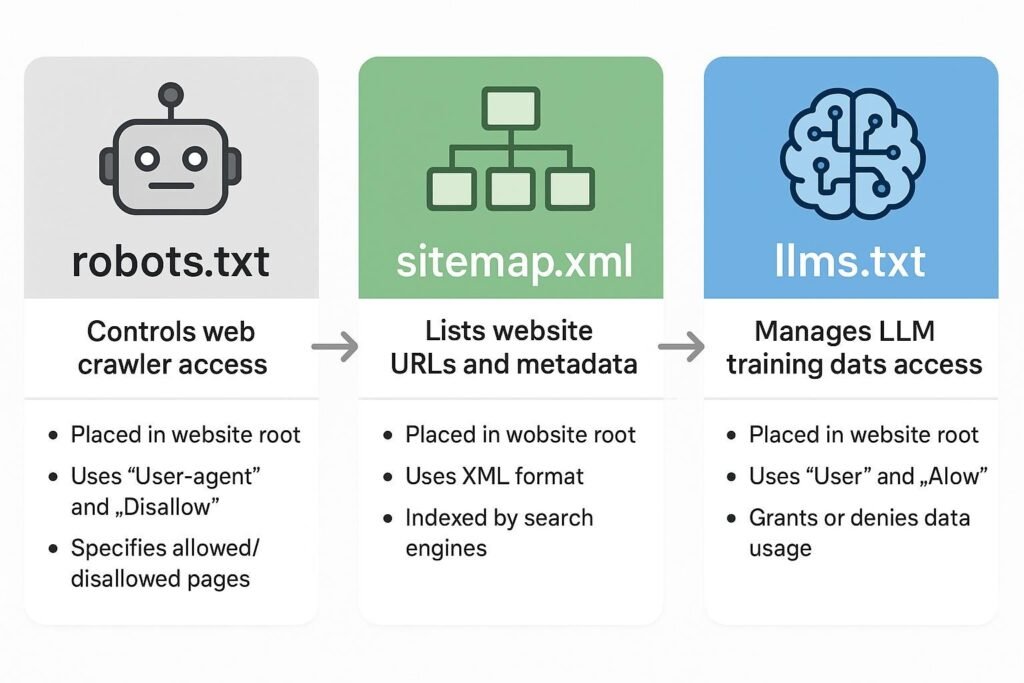
The llms.txt proposal specifically explains why a sitemap isn’t a substitute for llms.txt: a sitemap generally lists URLs rather than providing an LLM-friendly overview or consolidated content.
You can therefore have both.
For a normal website, the structure might be:
/robots.txt
/sitemap.xml
/llms.txt
/llms-full.txt
Each file has a different purpose.
llms-full.txt vs robots.txt
The names can make these files seem related, but they perform different jobs.
robots.txt communicates crawler access preferences.
llms.txt provides information intended to help AI agents understand a website and locate relevant resources.
A full-context file goes further by potentially providing the actual content in a consolidated Markdown resource.
The llms.txt proposal explicitly distinguishes its purpose from robots.txt: one is about providing context, while the other deals with crawler access instructions.
Common mistakes to avoid
Treating llms-full.txt as a Google ranking factor
Current Google guidance doesn’t support this.
Google says llms.txt isn’t needed for Search and doesn’t affect rankings positively or negatively.
Copying your entire website blindly
A huge file isn’t automatically useful.
Choose content that forms a coherent knowledge base.
Forgetting updates
If the file contains outdated information, it can become less useful than the current pages on your website.
Adding instructions that conflict with your website
Keep the information accurate and consistent with the actual site.
Assuming every AI system uses it
There is no guarantee that a particular AI service will fetch or process your file.
Replacing normal SEO with AI files
Your core SEO work still matters.
An llms-full.txt file cannot compensate for poor content, broken internal links, crawl problems, weak page structure, or an inaccessible website.
Does llms-full.txt replace llms.txt?
No.
They are better understood as different layers of the same general approach.
llms.txt provides a concise overview and links to important resources.
A full-context file can provide expanded content from those resources.
The current llmstxt.org proposal centers on llms.txt, while full-context files appear in related implementations and tooling.
Is llms-full.txt worth creating?
For a documentation-heavy website, testing it can make sense.
For a small SEO blog, I’d treat it as optional.
Start with the basics:
- Publish genuinely useful content.
- Organize related articles into clear topic groups.
- Use descriptive internal links.
- Keep important pages accessible.
- Maintain your XML sitemap.
- Keep technical SEO in good shape.
- Consider an
llms.txtfile if you have a useful reason for it. - Experiment with a full-context file only when the content and maintenance process justify it.
This keeps the AI-search work connected to the actual quality and organization of your website.
Final takeaway
llms-full.txt is best understood as an optional full-context companion to the broader llms.txt approach.
It can collect the content of selected pages into one Markdown resource, making that information easier for systems that support the convention to retrieve as a single document.
But it isn’t a magic SEO file, and Google does not require it for Search. Google currently says llms.txt files don’t affect Search visibility or rankings.
For most website owners, the sensible approach is to treat it as an experiment in AI-friendly content delivery while continuing to focus on the fundamentals that make a website useful to both people and search systems.
FAQs
What is llms-full.txt?
llms-full.txt is an emerging companion convention that can place the full content of selected website pages into one Markdown file for systems that support this approach.
Is llms-full.txt an official standard?
The current llmstxt.org v2 proposal defines llms.txt; llms-full.txt is not a required part of that core specification. It is used by some implementations as an expanded content file.
Does llms-full.txt improve Google rankings?
There is no documented Google ranking benefit. Google says llms.txt files aren’t needed for Google Search and don’t positively or negatively affect Search visibility or rankings.
What is the difference between llms.txt and llms-full.txt?
llms.txt provides a concise overview and links to important resources. A full-context file can contain the actual content from selected resources in one larger Markdown document.
Should I create llms-full.txt for my WordPress website?
It’s optional. It can be worth testing if your site has a substantial collection of related, well-organized content. A small blog may get more practical benefit from improving its existing content and site structure first.
Does ChatGPT automatically read llms-full.txt?
There is no universal guarantee that ChatGPT or another AI system will automatically fetch or use the file. Its usefulness depends on whether the particular system or tool supports and accesses the convention.