
You’ve probably checked a website’s Domain Authority (DA) or Domain Rating (DR) before deciding whether a backlink opportunity was worth pursuing.
Maybe your competitor has a score of 45 while your website sits at 18. Naturally, you start wondering what they’re doing differently.
Website authority is an SEO concept that helps estimate the strength of a domain, particularly its backlink profile and reputation across the web. SEO tools use their own scoring systems to measure this strength, which means the numbers can vary from one platform to another.
A stronger website authority profile can support your SEO efforts, especially when combined with relevant content, quality backlinks, and good website structure.
Let’s look at what website authority means, how to check it, and what you can do to improve it.
What Is Website Authority?
Website authority refers to the overall strength and credibility of a website within its industry or niche. In SEO, it’s commonly estimated through third-party metrics that examine factors such as backlinks, referring domains, and link quality.
Think of a website that regularly publishes useful marketing guides and receives backlinks from established marketing publications. Those links help search engines discover relationships between websites and pass ranking signals to linked pages.
As the website earns more relevant, high-quality backlinks, its authority metrics may increase.
Several SEO platforms measure website authority, but they use different names:
- Domain Authority (DA): Moz’s metric for predicting a domain’s ranking potential.
- Domain Rating (DR): Ahrefs’ metric for measuring the strength of a website’s backlink profile.
- Authority Score: Semrush’s metric that considers backlink quality, estimated organic traffic, and spam-related factors.
- Domain Trust Score: A Similarweb metric used to assess domain authority and trustworthiness.
These scores generally use a scale of 0 to 100, although their calculations and meanings differ.
Table of Contents
What Is an Authority Website?
An authority website is a website that people in a particular industry recognize as a reliable source of information.
For example, websites such as Moz, Ahrefs, and Search Engine Journal regularly publish SEO-related information, research, and practical guides.
They’ve built recognition through consistent publishing, industry expertise, and references from other websites.
An authority website usually has:
- Content written or reviewed by people with relevant knowledge.
- Backlinks from relevant and reputable websites.
- Clear information about its authors and business.
- Consistent coverage of its main subject.
- A website structure that makes information easy to find.
A smaller blog can also become an authority website within a narrow subject. A local accounting blog, for example, can build a strong reputation by publishing accurate, practical information for small business owners.
What Is Authority Score in SEO?
Authority Score is a metric developed by Semrush to estimate the overall quality and SEO strength of a website or webpage.
It uses a scale of 0 to 100 and considers 3 main areas:
- Link Power: The quality and quantity of backlinks pointing to a website.
- Organic Traffic: Estimated organic search traffic.
- Natural Profile: Signals that help identify unnatural or potentially manipulative backlink patterns.
Other SEO platforms use similar concepts with different calculations.
| SEO tool | Authority metric | Main measurement |
|---|---|---|
| Moz | Domain Authority (DA) | Predicted ranking potential |
| Ahrefs | Domain Rating (DR) | Backlink profile strength |
| Semrush | Authority Score | Link quality, organic traffic, and spam factors |
| Similarweb | Domain Trust Score | Domain authority and trustworthiness |
You should compare scores from the same platform when monitoring progress. A DA of 30 and a DR of 30 don’t mean the same thing.
How to Check Website Authority
You can check website authority using several SEO tools. Most let you enter a domain name and view its authority metric.
Here are 4 practical options.
1. Check Website Authority Using Moz
<image-placeholder>Image suggestion: Moz Link Explorer domain authority checker interface.</image-placeholder>
Moz provides Domain Authority (DA), a score that predicts how likely a website is to rank in search engine results compared with other websites.
Follow these steps:
- Visit Moz.
- Open its Link Explorer tool.
- Enter your website URL.
- Complete the verification if requested.
- Review your Domain Authority score and backlink information.
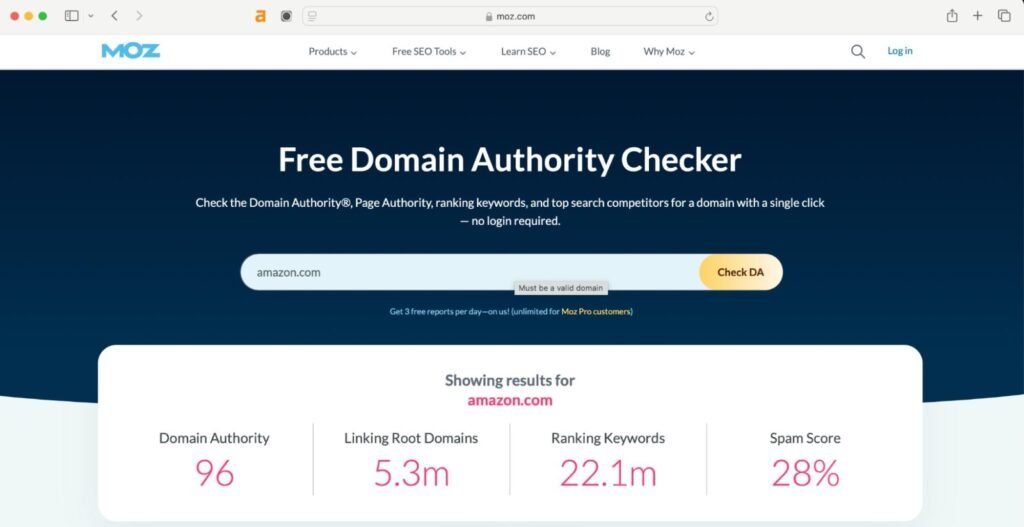
You can also check the DA of competitor websites to compare their backlink profiles with yours.
Moz calculates DA using its own link index and machine-learning model. The score is a comparative prediction, so it doesn’t guarantee a particular Google ranking.
2. Check Website Authority Using Ahrefs
<image-placeholder>Image suggestion: Ahrefs free website authority checker showing Domain Rating.</image-placeholder>
Ahrefs uses Domain Rating (DR) to measure the relative strength of a website’s backlink profile.
To check your DR:
- Visit the Ahrefs Website Authority Checker.
- Enter your domain name.
- Click the check button.
- Review the Domain Rating.
- Examine the referring domains and backlink information.
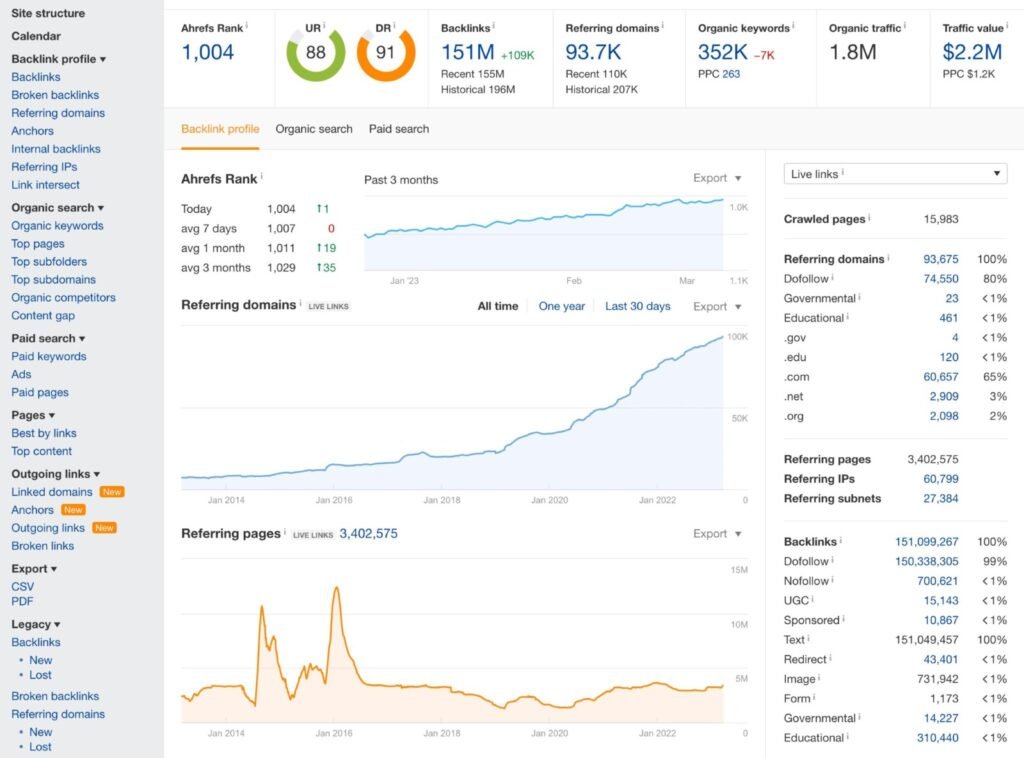
Ahrefs calculates DR using the number and quality of unique websites linking to your domain, along with how many other domains those websites link to.
A higher DR generally indicates a stronger backlink profile within the Ahrefs database.
3. Check Website Authority Using Semrush
<image-placeholder>Image suggestion: Semrush Website Authority Checker interface with Authority Score.</image-placeholder>
Semrush provides an Authority Score that combines backlink information, estimated organic traffic, and spam-related signals.
Here’s how to check it:
- Open the Semrush Website Authority Checker.
- Enter your website domain.
- Run the check.
- Review the Authority Score.
- Explore the backlink and organic traffic information.
You can use this information to compare your website with competitors and identify areas that need attention.
4. Check Website Authority Using Similarweb
<image-placeholder>Image suggestion: Similarweb Backlinks Analysis dashboard showing domain trust metrics.</image-placeholder>
Can you see Domain Authority on Similarweb?
Yes, Similarweb provides domain authority-related metrics through its backlink analysis tools. Its reporting includes metrics such as Domain Authority and Domain Trust Score, depending on the report and available product access.
To investigate a website:
- Visit Similarweb.
- Enter your domain or a competitor’s domain.
- Navigate to the SEO or Backlinks Analysis section.
- Open the relevant backlink or referring domains report.
- Review the available authority and trust metrics.
Similarweb also provides backlink information that can help you understand which websites link to a particular domain.
Keep in mind that Similarweb’s metrics are its own measurements. You won’t see Moz’s original Domain Authority score simply by checking a domain in Similarweb.
Can You Trust the Site Authority Metric?
Yes, authority metrics can be useful for SEO research, but you should understand what they measure.
Moz DA, Ahrefs DR, and Semrush Authority Score are third-party estimates. Google doesn’t use these publicly reported scores as direct ranking factors.
For example, a website with DR 60 isn’t automatically going to rank above a competitor with DR 30.
The second website might have more relevant content, stronger page-level backlinks, and a better match for the search query.
Here are 4 limitations to remember:
1. Different tools produce different scores.
Each platform has its own backlink database and calculation method. Your website might have DA 25 in Moz and DR 32 in Ahrefs.
2. A high score doesn’t guarantee good content.
A website can have a strong backlink profile while publishing outdated, inaccurate, or unhelpful information.
3. New websites usually have lower scores.
A recently launched website hasn’t had much time to earn backlinks and build recognition.
4. Scores can change without losing backlinks.
Competitors may gain new links, tool databases may change, and scoring systems may be updated.
Use authority metrics as comparison tools. Combine them with organic traffic, keyword rankings, referring domains, and backlink quality when evaluating a website.
How to Show Authority on Your Website
If you want visitors to trust your website, you need to give them clear reasons to do so.
Google’s Search Central documentation encourages website owners to make authorship, expertise, content quality, and the purpose of their website clear.
Here are practical ways to demonstrate authority.
1. Add Author Information
Readers should know who created the content and why they should trust that person.
Create an author profile that includes:
- Author’s name.
- Relevant experience or professional background.
- Areas of expertise.
- Links to professional profiles where appropriate.
- Other articles written by the author.
For example, an SEO blog can introduce its author as an SEO specialist who works with keyword research, technical SEO, and content optimization.
Keep the information accurate. Fake credentials and invented author profiles damage trust.
2. Create Helpful, Original Content
Your content should answer real questions and give readers information they can use.
For an SEO website, you could publish detailed guides about:
- Keyword research for small businesses.
- Technical SEO problems and their solutions.
- WordPress SEO settings.
- Backlink analysis.
- Content optimization.
Include practical examples, screenshots, original observations, and links to reliable sources where appropriate.
Google recommends publishing helpful, reliable, people-first content that demonstrates experience and expertise.
3. Create Clear About and Contact Pages
An About page explains who runs your website and what readers can expect from it.
Your Contact page gives visitors a way to reach you.
For a business website, include accurate business information and relevant contact details. Keep these pages accessible through your main navigation or footer.
4. Use Relevant Sources and References
When you publish factual information, support it with reliable sources.
For example, an article about Google Search updates can link to official Google Search Central documentation.
Citing relevant research and official documentation helps readers verify your information.
5. Keep Your Website Professionally Organized
A confusing website can make visitors question its reliability.
Use a clear navigation menu, descriptive page titles, readable fonts, and consistent formatting.
Make sure important pages are accessible, internal links work correctly, and visitors can find your main topics without unnecessary effort.
How to Improve Website Authority
Improving website authority takes consistent SEO work. Your main focus should be earning relevant backlinks and building a website that people have a reason to reference.
Here are 6 practical ways to improve it.
1. Earn High-Quality Backlinks
Backlinks are links from other websites pointing to your website.
They remain an important part of SEO because Google uses links to discover pages and understand relationships between websites.
Focus on earning links from websites that are relevant to your industry.
For example, if you publish SEO content, a link from a respected digital marketing blog is usually more relevant than a random link from an unrelated website.
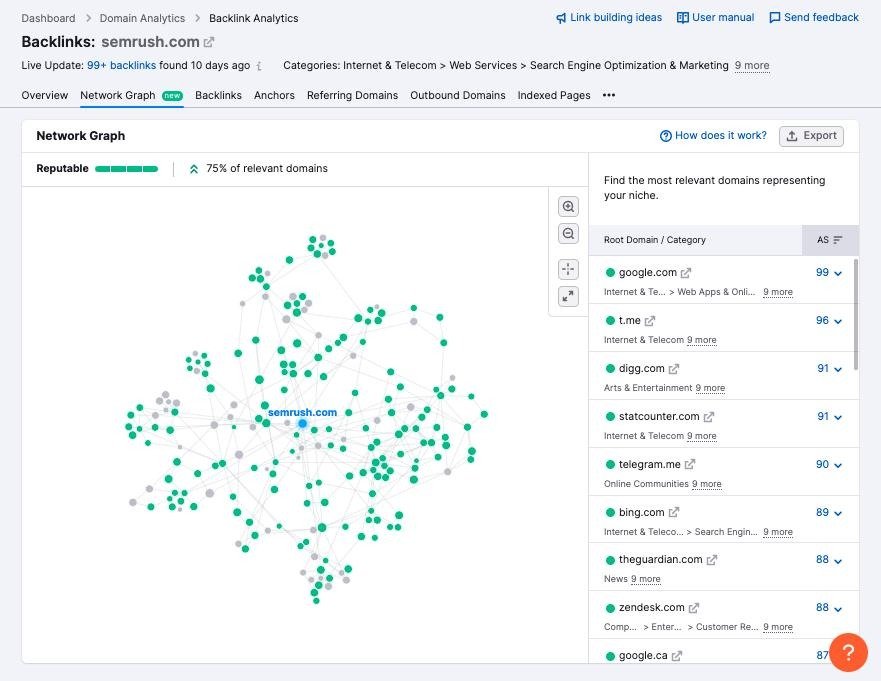
You can earn backlinks through:
- Guest contributions on relevant websites.
- Original research and useful resources.
- Industry interviews.
- Digital PR campaigns.
- Genuine partnerships and professional mentions.
Avoid buying bulk backlink packages that promise hundreds of links within a few days.
2. Publish Content People Want to Reference
Think about the type of information other website owners would naturally link to.
Original research, useful statistics, detailed tutorials, free templates, and practical case studies can attract references from relevant websites.
For example, you could publish a free technical SEO checklist for WordPress users.
Other bloggers might reference it when explaining how to audit a WordPress website.
3. Build Topical Authority
Topical authority develops when your website consistently covers a specific subject in useful detail.
Suppose your website focuses on SEO.
You can create related articles about keyword research, on-page SEO, technical SEO, link building, and content optimization.
Connect relevant articles through contextual internal links.

For example, your guide about website authority could link to your article about SEO silos, where readers can learn how to organize related content.
This creates a clearer relationship between your pages and helps visitors discover related information.
4. Improve Your Existing Content
Review your older articles regularly.
Check whether they contain outdated information, broken links, missing explanations, or examples that no longer apply.
Update the information where necessary and add useful details that answer questions readers might still have.
For example, if you published an article about backlink analysis 2 years ago, check whether the tools and instructions mentioned in it are still accurate.
You can also link older articles to newer, relevant guides.
5. Strengthen Your Internal Linking
Internal links connect different pages on your website.
They help visitors navigate related content and allow search engines to discover other pages.
Use descriptive anchor text that explains what the linked page covers.
For example:
- Learn how to perform keyword research.
- Read our guide to technical SEO.
- Understand how WordPress redirects affect SEO.
Avoid adding links to unrelated pages just to increase the number of internal links.
6. Maintain a Healthy Backlink Profile
Check your backlink profile regularly to understand which websites link to you.
Look for:
- New referring domains.
- Lost backlinks.
- Links from relevant websites.
- Unusual backlink patterns.
- Links that send actual referral traffic.
You can use Ahrefs, Semrush, Moz, or Similarweb for backlink research.
A sudden increase in low-quality backlinks doesn’t automatically mean your website has a problem. Review the actual links and their context before taking action.
How to Measure Website Authority Progress
Checking your authority score once isn’t enough to understand whether your SEO work is producing results.
Create a simple monthly tracking sheet.
| Metric | What to monitor |
|---|---|
| Domain Authority | Moz DA changes |
| Domain Rating | Ahrefs DR changes |
| Authority Score | Semrush score changes |
| Referring domains | New and lost linking websites |
| Organic traffic | Search traffic growth |
| Keyword rankings | Changes in target keyword positions |
| Backlink quality | Relevance and quality of linking websites |
Compare your website with 3 to 5 direct competitors.
For example, if your website has DR 20 and your competitors have DR 25, 28, and 35, you can investigate their referring domains and identify relevant websites that might also reference your content.
Track these metrics over several months. A small change in authority score doesn’t necessarily indicate a major improvement or decline in SEO performance.
Frequently Asked Questions
1. What is website authority?
Website authority is an SEO concept that describes the overall strength and credibility of a website. SEO tools estimate it through metrics such as Domain Authority, Domain Rating, and Authority Score.
2. What is the authority of a website?
The authority of a website refers to its estimated ability to compete in search results based on factors such as its backlink profile and reputation. Different SEO platforms calculate this using their own metrics.
3. How can I check website authority for free?
You can use free checking options from Moz, Ahrefs, and Semrush. Enter your domain into the relevant checker to see the available authority metric and backlink information.
4. Can you trust the site authority metric?
Yes, as a comparative SEO measurement. However, third-party authority scores aren’t official Google ranking factors and shouldn’t be used as the only measure of website quality.
5. Can you see Domain Authority on Similarweb?
Similarweb provides domain authority-related information through its backlink analysis reports, including Domain Authority and Domain Trust Score metrics in relevant reporting. These are Similarweb measurements, not Moz’s original DA score.
6. What is Authority Score?
Authority Score is Semrush’s metric for estimating the overall quality of a website or webpage. It considers backlink strength, estimated organic traffic, and spam-related signals on a scale of 0 to 100.
7. What is an authority website?
An authority website is a website recognized as a reliable source within a particular industry or subject. It generally has knowledgeable authors, useful content, and references from other relevant websites.
8. How can I show authority on my website?
Add accurate author profiles, publish original and helpful content, create About and Contact pages, cite reliable sources, and maintain a professional website structure.
9. How long does it take to improve website authority?
It depends on your website’s age, backlink profile, competition, and publishing activity. Building a strong reputation and earning relevant backlinks usually takes consistent work over several months or longer.
10. Does website authority directly affect Google rankings?
Third-party scores such as DA, DR, and Authority Score don’t directly affect Google rankings. They estimate aspects of SEO strength that can correlate with ranking performance, particularly backlink strength.
Final thoughts
Website authority gives you a useful way to compare your domain with other websites in your industry.
Start by checking your website with Moz, Ahrefs, or Semrush. Review your referring domains, examine competitor backlinks, and identify relevant websites that could reference your content.
Keep publishing useful information, maintain your existing articles, and build genuine relationships within your industry.
Over time, these efforts can help your website earn stronger recognition and compete for more organic search traffic.
Focus on the quality of your website and the links it earns. Let authority metrics help you measure the progress.