
How to Find Commercial Intent Keywords That Actually Convert
The fastest way to find commercial intent keywords that actually convert is to combine commercial modifiers (best, vs, review, alternatives) with free tools like Google Keyword Planner, Search Console, and autocomplete, then validate intent by checking the SERP and prioritising keywords with solid search volume plus higher CPC or proven conversion signals.
This approach surfaces keywords people use when they are actively comparing options and getting ready to buy, not just browsing for information.
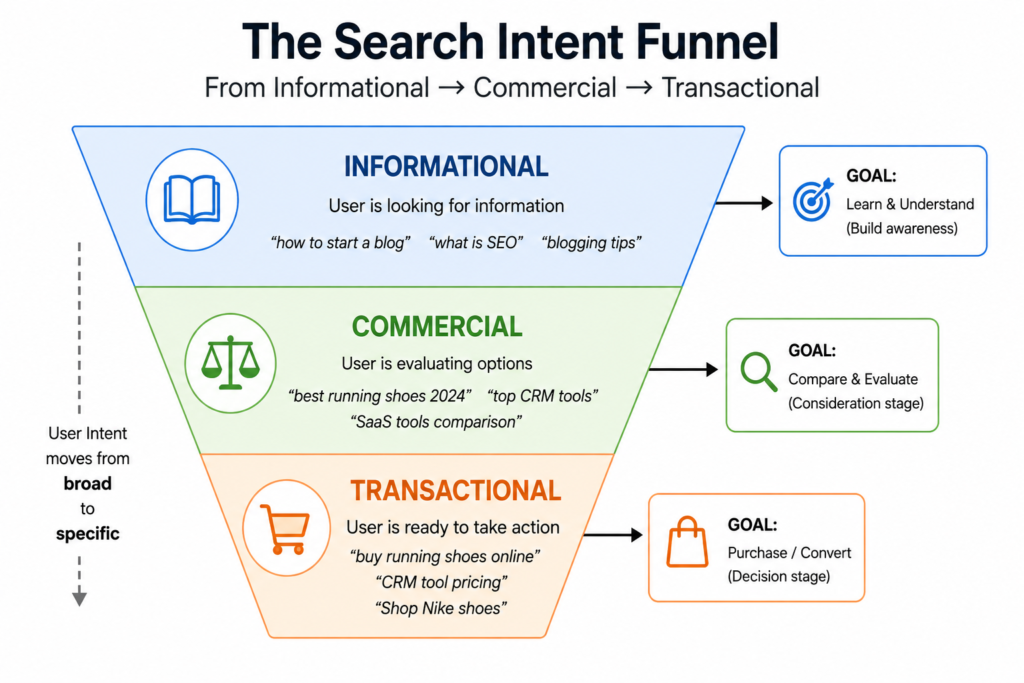
Most marketers chase high-volume informational keywords and wonder why traffic never turns into leads or sales. Commercial intent keywords sit in the middle of the funnel. Searchers already know they need a solution and are evaluating which one to choose.
Targeting these terms correctly can deliver higher conversion rates than pure informational content while facing less competition than pure “buy now” transactional terms.
In this guide you will learn exactly how to identify high-intent commercial keywords, use free and paid tools effectively, validate real conversion potential, and turn those keywords into content that ranks and converts.
Everything is practical, up-to-date for 2026, and built around methods that work whether you have a big SEO budget or none at all.
What Commercial Intent Keywords Really Mean (And Why They Convert)
Commercial intent keywords (also called commercial investigation keywords) are the queries people type when they are researching products or services before making a purchase decision. They have moved past “what is” or “how does it work” and are now asking which option is best for them.
Common signals include words like best, top, vs, review, alternatives, comparison, worth it, or specific use-case modifiers such as “for small business” or “under $50.”
These keywords convert better than pure informational terms because the searcher is already in evaluation mode. Industry data consistently shows commercial pages converting in the 2–5% range (sometimes higher) when the content matches intent, compared with under 2% for most informational content.
Transactional keywords convert even higher but are often dominated by ads and product pages, leaving more organic opportunity in the commercial layer.
Understanding this distinction is the foundation of learning how to find commercial intent keywords that actually convert.
How to Identify High-Intent Commercial Keywords
Start by looking for clear linguistic signals and then confirm with real search results.
Commercial Keyword Modifiers
These words almost always signal commercial intent:
- Best / Top / Leading / Recommended
- Vs / Versus / Compared to / Or
- Review / Reviews / Rating / Ratings
- Alternatives / Alternative to / Like / Instead of
- For [specific audience or use case]
- Worth it / Good for / Right for
- Affordable / Cheap / Under $X / Pricing (sometimes blends into transactional)
Examples of keywords with commercial intent:
- Best project management software for startups
- Ahrefs vs Semrush
- HubSpot review 2026
- Mailchimp alternatives
- Best CRM under $50/month
- Is Notion good for teams
SERP Validation (The Fastest Accuracy Check)
Open an incognito window and search the keyword. Look at what Google is ranking:
- Listicles, “best of” roundups, comparison tables, and review sites → strong commercial intent
- Product pages, shopping ads, pricing pages → more transactional
- Guides, definitions, and “how to” articles → informational
If the top results match the content format you plan to create, the keyword is a good fit. This manual check takes under a minute and prevents you from targeting the wrong intent.
Free Ways to Find Commercial Intent Keywords That Actually Convert
You do not need expensive tools to start. Here are reliable free methods.
1. Google Autocomplete and Related Searches
Type your seed keyword (for example “email marketing software”) into Google and note the suggestions. Add commercial modifiers: “best email marketing software”, “email marketing software vs”, “email marketing software review”.
Scroll to “People also ask” and “People also search for”. These sections are goldmines for real commercial language.
2. Google Keyword Planner
Create a free Google Ads account (you do not need to run ads). Go to Tools → Keyword Planner → Discover new keywords. Enter your product or service.
Look at the “Top of page bid (high range)” column. Higher suggested bids usually indicate stronger commercial value because advertisers only pay more for keywords that convert. Also note competition level and average monthly searches.
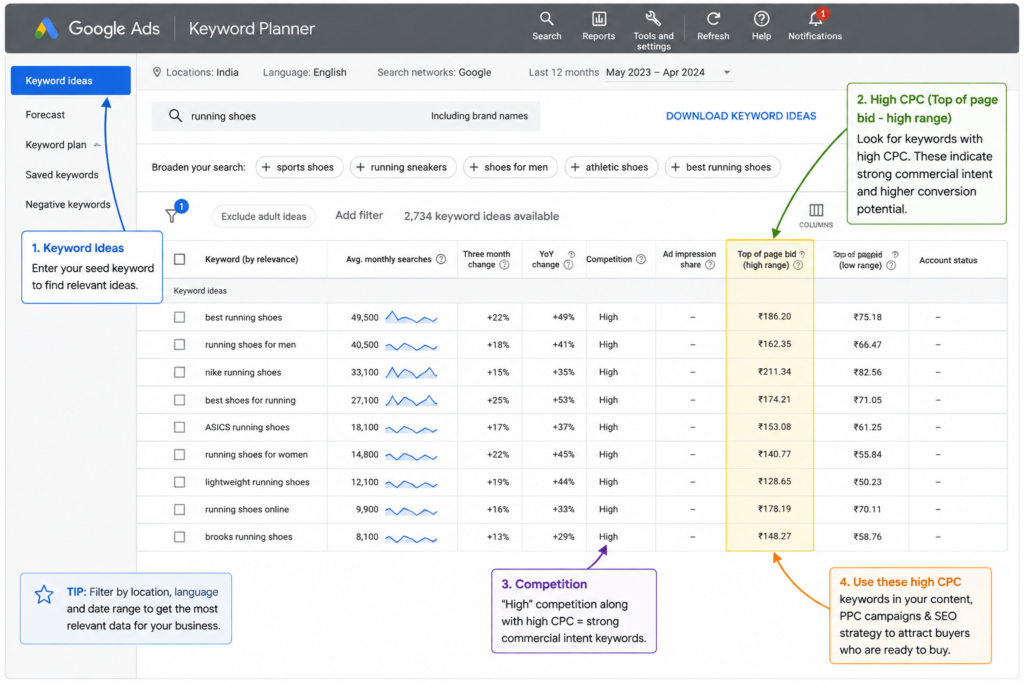
Export the list and filter manually for commercial modifiers. High CPC + commercial language is a strong conversion signal.
3. Google Search Console
If you already have a site, open Performance → Queries. Filter for terms containing “best”, “vs”, “review”, “alternative”, “pricing”, or “demo”. These are keywords you already rank for (even if only on page 2 or 3) that show commercial intent. Improving content around them often produces quick wins.
4. Google Trends and Community Research
Check seasonality and rising queries. Browse Reddit, Quora, and niche forums for the exact phrases prospects use when comparing options. Sales call transcripts and customer support tickets are also excellent sources of zero-volume but high-converting language.
These free methods alone are enough to build a solid list of commercial intent keywords that actually convert.
Using Keyword Tools and AI for Scale
When you are ready to expand, paid tools with intent filters save time.
Semrush and Ahrefs both classify keywords by intent. Enter a seed term, open the keyword report, and filter for “Commercial”. You instantly get volume, keyword difficulty, CPC, and SERP data for hundreds of commercial terms. Their competitor analysis tools also show which commercial keywords your rivals already rank for.
Google Keyword Planner remains useful even alongside paid tools because its bid data comes directly from advertisers.
Can You Use ChatGPT for Keyword Research?
Yes, with caution. Prompt it like this:
“Act as an SEO specialist. Generate 30 commercial intent keywords related to [your product/service]. Focus on modifiers such as best, vs, review, alternatives, and specific use cases. Group them by funnel stage.”
ChatGPT is excellent for ideation and long-tail variations, but it has no real search volume data. Always validate every suggestion in Keyword Planner, Ahrefs, or Semrush and by checking the live SERP. Treat AI as a brainstorming partner, not a data source.
How to Prioritise Keywords That Actually Convert
Not every commercial keyword is worth targeting. Use this simple prioritisation framework:
- Search volume – Enough monthly searches to justify the effort (even 100–500 can be valuable if conversion rate is high).
- Keyword difficulty / competition – Favour terms you can realistically rank for based on your domain authority.
- CPC / commercial value – Higher bids usually mean higher conversion potential.
- Business relevance – Does ranking for this keyword lead to leads or sales for your specific offer?
- Content fit – Can you create a page that genuinely helps the searcher evaluate options better than current results?
A practical table for prioritisation:
| Factor | Strong Signal | Weak Signal |
|---|---|---|
| Volume | 200+ monthly searches | Under 50 |
| CPC | $2+ top-of-page bid | Near $0 |
| Difficulty | Achievable for your site | Dominated by major brands |
| Intent match | SERP full of comparisons/reviews | Mixed or informational |
| Business fit | Directly leads to your product/service | Tangential |
Focus first on keywords that score well across most of these factors. Long-tail commercial terms often convert better than broad head terms because they attract more qualified traffic.
Creating Content That Matches Commercial Intent
Finding the keywords is only half the job. The content must satisfy the searcher’s evaluation needs.
- Use comparison tables, pros/cons lists, and clear ranking criteria.
- Include real screenshots, pricing context (when possible), and honest limitations.
- Answer common objections and “is it worth it” questions.
- Add clear next steps (demo, free trial, related comparison pages) without hard selling.
- Keep the tone helpful and balanced , searchers can detect sales fluff instantly.
Common Mistakes to Avoid
- Treating every keyword with a commercial modifier as automatically high-converting without checking the SERP.
- Creating generic “best of” lists that add no unique insight.
- Ignoring your own Search Console and analytics data.
- Chasing volume at the expense of relevance and conversion potential.
- Using AI-generated content without heavy human editing and real expertise.
Conclusion and Next Steps
Learning how to find commercial intent keywords that actually convert comes down to three habits: recognise the linguistic signals, validate with SERP and data tools (especially free ones like Keyword Planner and Search Console), and prioritise based on real conversion potential rather than vanity volume.
Start today by taking one of your core products or services, generating a list of commercial modifiers, running them through Google Keyword Planner, and checking the top five results for each promising term. Within an hour you will have a shortlist of high-potential keywords.
From there, create content that genuinely helps searchers evaluate their options. That combination of the right keywords and intent-matched content is what turns search traffic into customers.
If you want to go deeper, review your existing high-performing pages in Google Search Console for commercial queries you are already ranking for and strengthen them first. Small, focused improvements on commercial intent keywords often deliver faster results than chasing brand-new informational topics.
FAQs
How do you identify high-intent commercial keywords?
Look for modifiers such as best, vs, review, alternatives, and “for [use case]”. Then search the term and confirm the SERP shows comparison articles, reviews, or evaluation-focused results rather than pure how-to guides or product pages.
What are some examples of keywords with commercial intent?
Best CRM for real estate, Semrush vs Ahrefs, best noise-cancelling headphones under $200, HubSpot alternatives, is Notion worth it for teams, top project management tools 2026.
Can I use ChatGPT for keyword research?
Yes for idea generation and long-tail variations. Always validate volume, difficulty, and real intent with Google Keyword Planner or a dedicated SEO tool and by checking the live search results.
How is commercial intent different from transactional intent?
Commercial intent is evaluation and comparison (“best X”, “X vs Y”). Transactional intent is ready-to-buy action (“buy X”, “X pricing”, “X discount code”). Commercial keywords often have more organic ranking opportunity.
Is Google Keyword Planner still useful in 2026?
Yes. It remains one of the best free sources of search volume ranges and, more importantly, advertiser bid data that signals commercial value.
Look for modifiers such as best, vs, review, alternatives, and “for [use case]”. Then search the term and confirm the SERP shows comparison articles, reviews, or evaluation-focused results rather than pure how-to guides or product pages.
Best CRM for real estate, Semrush vs Ahrefs, best noise-cancelling headphones under $200, HubSpot alternatives, is Notion worth it for teams, top project management tools 2026.
Yes for idea generation and long-tail variations. Always validate volume, difficulty, and real intent with Google Keyword Planner or a dedicated SEO tool and by checking the live search results.
Commercial intent is evaluation and comparison (“best X”, “X vs Y”). Transactional intent is ready-to-buy action (“buy X”, “X pricing”, “X discount code”). Commercial keywords often have more organic ranking opportunity.
Yes. It remains one of the best free sources of search volume ranges and, more importantly, advertiser bid data that signals commercial value.